Data Hygiene & Segmentation is the most important step for your business growth in 2026. If your contact list is full of errors, you are just throwing money away on ads that nobody sees. By keeping your database health in top shape, you ensure your marketing hits the right inbox every time.
Good list management helps you avoid spam folders and lowers your customer acquisition costs significantly. When you organize your contacts the right way, you gain the power to send messages that actually convert.
So, take control of your marketing database today. A clean, well-segmented list is your best tool for long-term success and higher revenue across all your campaigns.
What Is Data Hygiene and Why Does It Matter?
Data hygiene is the ongoing practice of maintaining clean, accurate, and structured databases by removing, updating, or fixing corrupted, inaccurate, or duplicate records.
It matters because high-quality data serves as the foundation for every marketing decision, ensuring that campaigns reach actual humans rather than dead ends or irrelevant targets for your business growth.
The Cost of Dirty Data in Modern Marketing
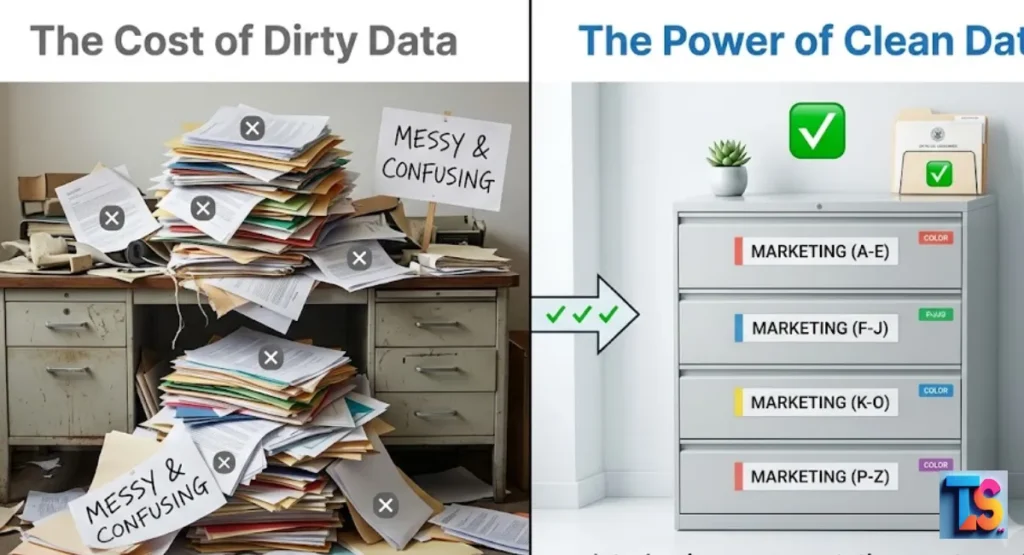
Dirty data creates a hidden tax on marketing performance. When your database contains outdated contacts, duplicate entries, or invalid formatting, your systems trigger bounce-backs and blocklists.
This inefficiency drives up Customer Acquisition Costs, as you pay to target prospects who no longer exist or have no interest in your current professional offerings.
Data Hygiene vs. Data Quality: Understanding the Difference
| Feature | Data Hygiene | Data Quality |
| Primary Goal | Maintaining current list health | Measuring information accuracy |
| Nature | Continuous, active process | Benchmarking standard metric |
| Output | Clean, usable contact list | Trustworthy, validated data set |
The Critical Role of Data Hygiene in Building Better Customer Segments
Data hygiene transforms raw contact lists into actionable segments by ensuring that every record is verified and correctly categorized. Without clean data, segmentation logic fails because the criteria rely on flawed inputs.
Properly maintained data allows marketers to move beyond broad targeting into highly specific, high-conversion audience groups for better campaign returns.
How Clean Data Powers Hyper-Personalization
Hyper-personalization requires granular data points, such as recent purchase history, browsing behavior, and specific geographic location. Clean data ensures these attributes are correctly mapped to the right individual.
When your records are accurate, you can dynamically insert personalized content that feels tailored rather than generic, significantly increasing engagement across your entire digital presence.
Reducing Customer Acquisition Costs Through Accurate Profiling
Accurate profiling eliminates waste. When you segment based on verified attributes, your ad budget focuses exclusively on the highest-probability prospects.
By choosing to Filter Competitor Domains from Lead Lists early, you optimize your conversion funnels, ensuring that every dollar spent contributes directly to lead generation rather than wasting resources on irrelevant database bloat.
Improving Email Deliverability and Engagement Rates
Email service providers track engagement signals to determine your sender reputation. Dirty data leads to high bounce rates and spam complaints, which force your emails into the junk folder.
You should Separate Personal and Business Emails in Bulk to keep your sender score high, ensuring that your communication reaches the primary inbox of your prospects.
Common Data Hygiene Issues That Sabotage Segmentation
Common data issues include duplicate records, inconsistent naming conventions, and incomplete fields, all of which distort segmentation logic.
These problems prevent marketing platforms from accurately grouping leads, resulting in fragmented campaigns that fail to deliver the intended message to the right person at the right time, causing significant confusion for your internal teams.
Duplicate Records and Data Silos
Duplicate records inflate subscriber counts and cause message fatigue, where a single lead receives the same email multiple times. Data silos where information remains trapped in isolated systems further complicate this by preventing a unified view of the customer.
Integrating these sources is the only way to achieve a single source of truth today.
Incomplete or Missing Data Fields
Segmentation relies on specific variables like job titles, company sizes, or geographic regions. If your CRM has missing fields, your segments will exclude otherwise qualified prospects.
Incomplete data forces marketers to rely on guesswork rather than evidence, leading to missed opportunities and inefficient campaign targeting that fails to reach your ideal audience profile.
Outdated or Inaccurate Contact Information
People change jobs, companies shift focus, and phone numbers become disconnected. Outdated contact information represents a wasted opportunity.
Regularly choosing to Check Active WhatsApp Numbers in Bulk against current data providers ensures that you are reaching active, relevant decision-makers rather than trying to contact someone who has long since moved on elsewhere.
Inconsistent Formatting and Naming Conventions
Variations such as St. versus Street or different country code formats break automated segmentation filters. If your database contains inconsistent entries, your system cannot group these leads together.
Standardizing formatting across all data entry points is necessary to ensure that your automation rules function correctly and reliably for every single contact record.
5 Data Hygiene Routine Steps to Power Better Customer Segments
Establishing a rigorous routine involves auditing current assets, enforcing strict entry standards, and automating the validation process.
By integrating these steps into daily operations, teams prevent data decay and maintain a high-value list that is ready for immediate deployment in segmented marketing initiatives, ensuring your outreach remains both professional and highly targeted.
1. Begin with a Comprehensive Data Audit
A data audit identifies where your information is broken, duplicate, or missing. Review your CRM and marketing platforms to determine the percentage of bounce rates, the frequency of duplicate entries, and the volume of inactive records.
Use this audit as a baseline to prioritize which segments require immediate cleanup for improved campaign performance.
2. Establish Uniform Data Standards and Governance
Define how data must be entered and managed across your organization. Create a data dictionary that specifies naming conventions, required fields, and acceptable formats.
Ensure that every team member follows these standards to prevent the accumulation of junk data that creates chaos in your segmentation filters and weakens your overall marketing results.
3. Implement Automated Validation at Point of Entry
Stop the problem before it starts by using automated validation tools on all web forms and CRM imports. These tools verify email addresses in real-time, ensure phone numbers are valid, and confirm that required fields are filled correctly.
This gatekeeping strategy preserves the integrity of your incoming lead flow for future use.
4. Proactive Duplicate Detection and Merging
Use automated de-duplication tools to identify records that share identifiers such as email addresses or unique CRM IDs.
Configure your systems to automatically merge these records based on predefined rules, ensuring that the most recent information is retained while consolidating the activity history into a single, comprehensive customer profile for your marketing department.
5. Regular Data Enrichment and Updates
Data decays over time as contacts move to new roles or companies. Use third-party enrichment services to fill missing fields and verify the accuracy of existing information periodically.
This turns a stagnant contact list into a dynamic asset, providing you with the most current insights to fuel your segmentation strategies effectively every day.
Types of Data Segmentation to Optimize Your Campaigns
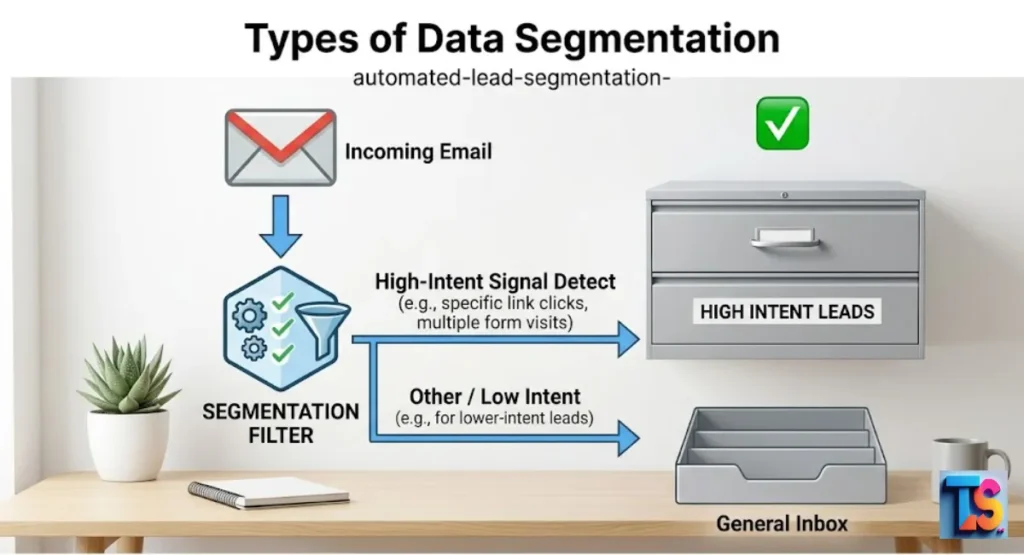
Segmentation categorizes your audience based on shared characteristics, allowing for targeted communication that resonates with specific needs.
By applying these categories to your clean data, you can build campaigns that feel relevant to the user, thereby increasing response rates and fostering stronger relationships with your prospect base for long-term business success.
Demographic Segmentation
This method groups audiences by objective attributes like age, gender, job title, company size, or industry.
It serves as the most basic layer of segmentation, helping you tailor your language and offer type to the specific professional or personal profile of your target market segment for a better connection with potential buyers.
Psychographic Segmentation
Psychographic segmentation focuses on the internal motivators, interests, lifestyle, and values of your audience. While more difficult to quantify, it allows for highly resonant messaging.
By understanding why a prospect buys, you can frame your value proposition to match their mindset, beliefs, and long-term goals, resulting in much higher brand loyalty.
Geographic Segmentation
Geographic segmentation groups users based on physical location, such as country, city, or even specific coordinates. You can Map Google Maps Coordinates to Excel to gain deeper insights.
This is essential for companies with regional offerings, local events, or location-specific regulations, allowing for hyper-local campaigns that address the specific context of that region.
Behavioral Segmentation
Behavioral segmentation tracks how users interact with your business, including purchase history, website activity, email engagement, and customer journey stage.
This is the most effective way to identify high-intent leads. By observing actions, you can trigger specific automation sequences that move a prospect closer to a purchase decision with extreme precision today.
Automating Data Hygiene for Scalable Growth
Automation replaces manual list scrubbing with real-time, intelligent filtering that keeps databases accurate without constant human intervention.
By integrating automated workflows, businesses scale their marketing efforts while maintaining high data standards, ensuring that segmentation logic remains effective even as the total volume of leads increases significantly over time for your growing company.
To achieve scalable results, implement a programmatic workflow that connects your web forms directly to a data verification API. This bridge ensures that every incoming lead is validated, standardized, and tagged before it enters your central database.
Use automated scripts to trigger daily deduplication cycles, ensuring your segments reflect the most accurate, real-time prospect information.
Best Practices for Maintaining Long-Term Data Integrity
Long-term integrity requires a culture of accountability where data is viewed as a strategic asset rather than an administrative burden.
Regularly review your segmentation rules, perform quarterly deep-dives into your database health, and provide ongoing training for teams to ensure that everyone understands the importance of precise, clean data for consistent results.
Establish a formal data governance protocol that includes monthly health reports and mandatory staff training. Appoint a team member to manage a recurring checklist that verifies field consistency across all departments.
By auditing integration touchpoints every ninety days, you prevent long-term data decay and maintain a clean, high-performance environment for all ongoing marketing operations.
FAQs
What is the difference between data hygiene and data cleansing?
Data hygiene is a continuous, proactive maintenance strategy that prevents errors from entering your system. Data cleansing is typically a reactive, one-time project aimed at fixing existing errors in an already corrupted dataset. Hygiene is about prevention, while cleansing is about fixing historical issues to restore the value of your contact list.
How does poor data hygiene affect marketing automation platforms?
Poor hygiene causes automation to fail by triggering sequences for the wrong leads or creating endless loops of duplicate messages. It also ruins your sender reputation, as bounce rates and low engagement force your marketing emails into spam folders, rendering your marketing automation platforms largely ineffective for your overall revenue growth goals.
Can AI improve the accuracy of customer segmentation?
Algorithmic systems significantly improve segmentation accuracy by processing vast amounts of behavioral and demographic data to identify patterns that humans miss. Automated workflows categorize complex data, dynamically adjust segments based on real-time interactions, and predict which prospects are most likely to convert, leading to much higher campaign precision for your marketing department.
How often should a business perform a data hygiene audit?
A comprehensive data hygiene audit should occur at least every quarter. However, for high-growth businesses with large volumes of incoming leads, monthly reviews are recommended. Frequent audits ensure that your data remains an accurate reflection of your market, preventing the gradual buildup of inconsistencies that sabotage your campaigns and waste your budget.
The Bottom Line
That data hygiene and segmentation are the essential pillars of modern marketing ROI. By auditing your data, enforcing strict standards, and automating the maintenance process, you build a reliable foundation for hyper-personalization.
Clean data reduces costs, improves deliverability, and ensures that your marketing efforts reach the right people with the right message every time. This approach guarantees maximum return on your marketing investment through reduced waste, while also driving enhanced audience engagement via precise, relevant messaging.
Ultimately, you will see increased operational efficiency as you rely on automated verification workflows to keep your database accurate and ready for growth.