Building a business that lasts starts with a steady flow of new clients. Many agencies struggle because they rely on expensive, one-time marketing tricks that stop working fast.
True success happens when you build automated systems that bring in the right people without constant manual effort. Strategic planning for scaling a marketing agency is essential to ensure these systems evolve alongside your growing client base.
By moving away from the often conflicting methodologies of growth hacking and traditional marketing agency structures, you can create a hybrid approach that prioritizes long-term sustainability over short-term gimmicks.
Additionally, choosing whether to outsource vs. build an in-house lead gen team is a pivotal decision that dictates how quickly you can achieve consistent, high-quality pipeline growth.
By focusing on your ideal customer profile, you stop chasing low-quality leads and start building real value. This approach lowers your costs while making your income more predictable for the future.
You need client acquisition models for long-term growth to turn strangers into long-term partners. Use these proven lead generation strategies to gain market authority and sales funnel optimization to keep your agency growing year after year.
The Core Shift: Why Short-Term Acquisition Hacks Fail Sustainable Growth
Short-term hacks provide quick bursts of traffic but rarely build lasting value. These tactics often depend on expensive ads that stop working the moment you stop paying.
Because they focus on volume rather than fit, these leads are often low quality, leading to high churn rates and wasted sales efforts for your entire team.
You build assets for sustainable growth. When you invest in search engine optimization, brand authority, and community, you create an engine that generates leads on its own.
This organic-first growth loop reduces your reliance on paid platforms, which allows you to forecast cash flow with 90% accuracy for your agency’s long-term planning.
The Hidden Costs of Chasing Fluffy Volume Over Value
Chasing volume often forces agencies to lower their prices to attract anyone who will sign a contract. This creates a cycle where you must work harder for less money.
Managing low-value clients takes time, fills your team with busy work, and prevents you from focusing on the high-value projects that actually grow your agency.
You target clients who need your specific expertise by prioritizing value. These clients stay longer, pay more, and are easier to satisfy. By avoiding the trap of high-volume, low-quality leads, you protect your profit margins and ensure your agency has the bandwidth to deliver high-quality work that builds your authority in the market.
Acquisition vs. Retention: Balancing the Scale for Lifetime Value (LTV)
You must balance getting new clients with keeping the ones you already have. Acquisition brings in the cash flow, but retention builds the profit. If you lose clients as fast as you sign them, you will never grow.
A healthy model keeps acquisition costs low while raising the total value of each client over time.
| Metric | Focus for Growth | Financial Impact |
| Acquisition | Attracting the right fit | High upfront CAC |
| Retention | Delivering ongoing value | Increases LTV |
| LTV | Maximizing total profit | Ensures long-term scale |
What Is a Sustainable Client Acquisition Model?
A sustainable client acquisition model is a repeatable system that brings in new business at a predictable cost. It uses data to track exactly where leads come from and how much effort is needed to turn them into paying clients.
This removes the guesswork from your sales process and ensures growth through smart, consistent habits.
You integrate your marketing, sales, and service departments within this model. By aligning these teams, you ensure that the people you bring in are actually a good fit for your agency.
This creates a smooth flow from the first touchpoint to the final contract, making it easy to scale as you grow and optimize workflows.
The Three Operational Pillars: Traffic Sources, Conversion Funnels, and Budget Yield
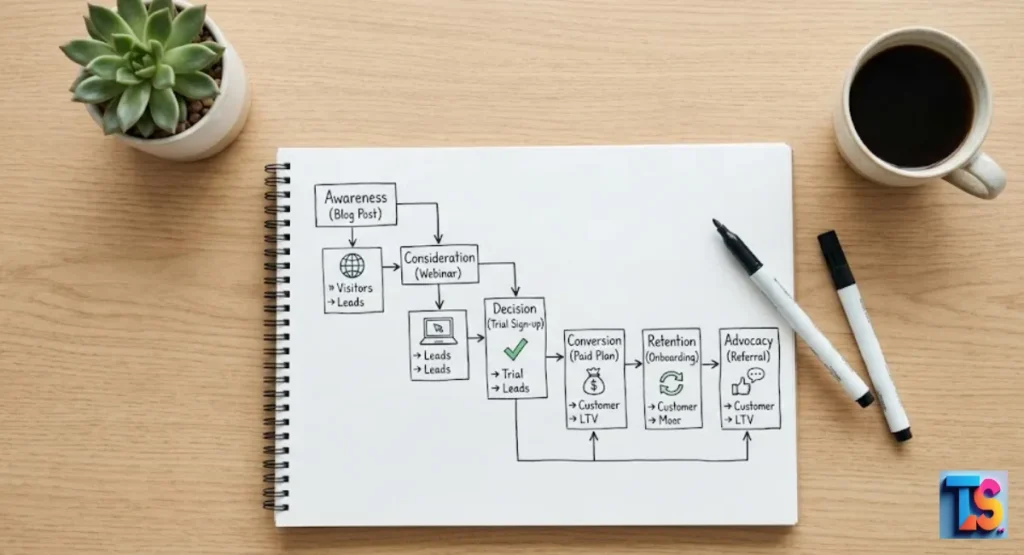
These three pillars support your entire growth strategy. Traffic sources provide the eyes on your brand, conversion funnels turn those visitors into buyers, and budget yield ensures you spend money wisely.
If one pillar is weak, your entire system struggles to produce consistent, profitable results for your agency in a very competitive market environment today.
- Traffic Sources: You focus on channels where your target clients spend time, such as search engines or industry platforms.
- Conversion Funnels: You simplify the path from first visit to signed contract by removing friction.
- Budget Yield: You measure the return on every dollar spent to ensure you are not wasting capital.
Defining Your Ideal Customer Profile (ICP) for High-Efficiency Targeting
Your Ideal Customer Profile is a detailed description of the exact company that gets the most value from your services. It includes industry type, company size, and specific pain points.
Knowing this helps you ignore bad leads early, saving your sales team hours of wasted time on prospects that will never sign a contract today.
You make your messaging sharper and more persuasive when you define your ICP. You stop trying to speak to everyone and start speaking directly to the people who are ready to buy.
This targeted approach increases your conversion rates and helps you build a reputation as an expert in your niche, which drives better results.
4 Proven Sustainable Client Acquisition Models
There are four primary ways to build a long-term model that scales without manual effort. Each strategy targets a different stage of the buyer journey, ensuring you have diverse touchpoints.
By selecting the right model for your specific agency strengths, you create a stable, predictable, and highly efficient flow of new high-value clients.
- The Product-Led Growth (PLG) Model: You use your service as the primary driver of acquisition. You offer a small, specific starter project or a specialized tool that delivers immediate results. This builds trust quickly and proves your value before the client commits to a larger, long-term contract. It turns the sales process into a demonstration of your actual work.
- The Content-Driven SEO and Authority Model: You focus on answering the specific questions your clients ask during their research phase. By creating high-quality articles, guides, and case studies, you become the go-to expert in your field. This draws in high-intent traffic from search engines without needing to pay for every single click, effectively lowering your costs over time.
- The Account-Based Marketing (ABM) Model for High-Value Clients: You treat individual high-value accounts as if they were their own markets. You create personalized campaigns and outreach for specific companies you want to work with. While this requires more effort per lead, the potential payoff is much higher, making it ideal for enterprise-level agency contracts and long-term revenue stability.
- The Partner Ecosystem and Inbound Referral Model: You build relationships with other agencies or software companies that serve your target audience but do not compete with you. By helping them solve their clients’ problems, you become a trusted referral partner. This provides a steady, low-cost stream of high-quality leads that are already vetted by someone they trust.
| Model | Primary Strength | Best For |
| Product-Led | Rapid Trust | Small, fast projects |
| Content-SEO | Long-term Traffic | Brand authority building |
| ABM | High Deal Value | Large enterprise clients |
| Partnerships | Low-Cost Leads | Trusted referrals |
Building and Forecasting Your Acquisition Model for Financial Predictability

Forecasting allows you to see the future of your agency based on current data. By tracking your conversion rates at every stage, you can estimate exactly how much effort and money you need to hit your growth targets.
This creates financial peace of mind and allows you to make hiring decisions with great confidence. Scaling Agency Infrastructure is essential to handle this growth, ensuring that as you increase your lead flow, your operations remain efficient and capable of maintaining service quality.
You use these methods to keep your agency’s growth on a stable track.
Bottom-Up vs. Top-Down Customer Acquisition Cost (CAC) Forecasting
Bottom-up forecasting starts with individual campaign data to build a total view of costs. This approach provides granular detail into what works best. Top-down forecasting takes your target revenue and works backward to see what you can afford to spend.
Both methods together give you a balanced view of your financial health and future growth.
Blending Paid and Organic Channels to Lower blended CAC
The most successful agencies mix paid ads with organic efforts like SEO. Paid ads provide the immediate volume, while organic efforts lower your long-term costs.
Over time, as your organic traffic grows, your blended cost per acquisition drops, making your business more profitable and resilient to market changes and competitive shifts in the industry.
The Power of Scenario Analysis in Long-Term Revenue Modeling
Scenario analysis means testing what-if situations. What if your lead volume drops? What if your conversion rate improves? By running these models, you prepare your agency for different market conditions.
This proactive planning uses predictive revenue modeling to guide your future decisions, which helps you mitigate financial risk and secure your agency’s long-term profitability.
Beyond the Basics: Integrating Daily CAC Modeling and Predictive Intelligence
Advanced agencies track their Customer Acquisition Cost daily to spot trends before they become problems. If your costs start to creep up on a Tuesday, you investigate it immediately rather than waiting for the end of the month.
Using predictive data helps you adjust your strategy before profit margins vanish from your business account.
Scaling Your Acquisition Model with Data and Technology
Scaling successfully requires you to leverage data as your primary guide for decision-making. By automating qualification and using first-party insights, you reduce human error and ensure that your sales team focuses only on high-intent prospects.
This technical foundation allows your agency to handle larger volumes of clients without increasing your internal operational overhead or costs.
Leveraging First-Party Data to Navigate Platform Fatigue
You leverage first-party data to navigate platform fatigue, which happens when your audience stops responding to standard ads. Information you collect directly from your website visitors allows you to create highly relevant, personalized experiences.
This makes your marketing stand out and helps you maintain high engagement even as generic advertising becomes less effective today.
Using Data Enrichment and API Integrations for Real-Time Qualification
Data enrichment tools automatically fill in the gaps in your lead information, such as company size or revenue. When a lead fills out a form, your system immediately checks if they match your ICP.
This allows your team to prioritize high-value prospects instantly and ignore time-wasters through smart, AI-assisted qualification processes and tools.
Aligning Marketing, Sales, and Success Teams Around Shared Metrics
When marketing, sales, and success teams share the same goals, friction disappears. The metrics should focus on the entire journey, not just the initial sale.
By aligning everyone on Client Lifetime Value rather than just Lead Count, you ensure that the whole company works together to grow the agency profitably and maintain strong, lasting relationships.
Practical Scenarios: Diagnosing and Fixing Your Acquisition Model Friction
This section helps you fix common growth problems by looking at your data. You can identify exactly where your model breaks down by checking your funnel.
Use these quick fixes to adjust your strategy when traffic, leads, or profit margins fail to hit the targets you set for your agency growth every single month.
| Scenario | Primary Symptom | Best Fix |
| A | High Bounce | Misaligned Messaging |
| B | Low Sales | Unqualified Leads |
| C | High CAC | Paid Media Reliance |
Key Metrics to Keep Your Lifecycle Growth Model Honest
- CAC (Customer Acquisition Cost): The total cost to gain one new client.
- LTV (Lifetime Value): The total revenue a single client generates.
- Churn Rate: The percentage of clients who leave your agency each month.
- Payback Period: How many months it takes for a new client to cover their own acquisition cost.
FAQs
What is the difference between client acquisition and lead generation?
Lead generation is the act of collecting contact information from potential customers. Client acquisition is the full process of turning those leads into paying, long-term partners. You can have many leads but still fail at acquisition if your sales process does not effectively convert them into signed contracts through a clear, repeatable system.
Why is a sustainable acquisition model crucial for investor-ready financial forecasts?
Investors look for predictability. They want to see that you understand your costs and have a clear, repeatable path to growth. A sustainable model proves that your agency can scale its revenue without its costs spiraling out of control, which significantly increases your business valuation while showing you understand long-term, predictive revenue modeling.
How does data intelligence directly lower Customer Acquisition Cost (CAC)?
Data intelligence allows you to stop spending money on channels or leads that do not convert. By using real-time qualification and behavioral data, you focus your budget only on the prospects most likely to buy, which prevents wasted spend and lowers your overall cost to acquire a customer through more targeted, efficient marketing efforts.
What are the three phases of a healthy client acquisition lifecycle?
The three phases are Awareness, Consideration, and Conversion. In the Awareness phase, you attract the right audience. In the Consideration phase, you provide value and demonstrate expertise. In the Conversion phase, you remove friction and guide the client to a clear, simple decision to start working with your agency for the long term.
Summary
Sustainable growth is not about finding a magic trick; it is about building a system that improves every day.
By focusing on your Ideal Customer Profile, balancing your traffic channels, and obsessing over data, you turn your agency into a reliable machine.
Start by optimizing one part of your funnel today, and build momentum.