Choosing between an outsource vs. build an in-house lead gen team strategy is a big step for your business. Every growing company needs a steady flow of new customers to stay ahead. If you get this choice wrong, you might waste your marketing budget or slow down your revenue growth.
Some firms find that hiring an outside agency offers the fast execution needed to scale quickly. Others prefer keeping their sales pipeline internal to maintain full brand control and deep product knowledge.
It all depends on your current resources and how fast you need results. Let’s look at the best way to choose the right path for your firm.
Key Takeaways
- In-house teams offer high control, perfect brand alignment, and direct daily communication, but require high upfront costs and long hiring times.
- Outsourced agencies deliver fast setup, lower initial costs, and instant access to experts, but offer less direct control over daily tasks.
- The best choice depends on your current budget, how fast you need to grow, and your long-term plans for Scaling Agency Infrastructure.
- Hybrid models combine both approaches to maximize pipeline growth while keeping costs manageable.
The Core Comparison: In-House vs Outsourcing
Choosing between an internal sales team and an external partner is a pivotal moment for any business. You must evaluate your budget, growth goals, and available time to make the right choice.
Both methods change how you find potential clients, spend your money, and manage your daily corporate work schedules over multiple quarters.
Strategic planning for scaling a marketing agency requires you to weigh these operational factors to ensure long-term success and a healthy return on your sales investment.
1. Cost & The True Cost of In-House SDRs
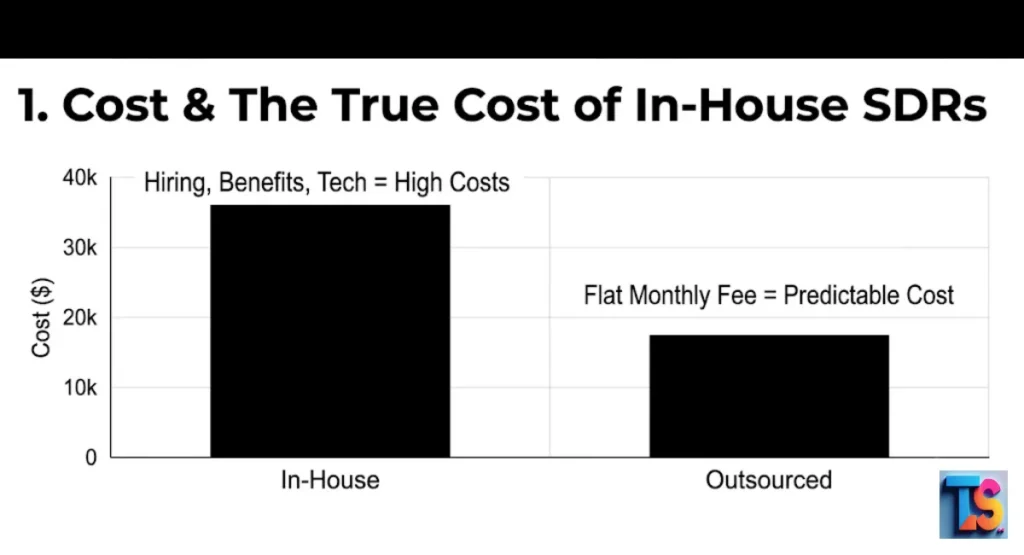
Building an internal acquisition infrastructure brings heavy financial obligations that impact your long-term budget planning. Choosing between regular payroll or a vendor agreement alters your baseline overhead and changes your financial flexibility.
You must look at salaries, software costs, and benefits to calculate the total budget you need for success.
In-house lead generation requires paying regular employee salaries, benefits, software licenses, and management overhead. Outsourcing turns these fixed costs into a predictable monthly fee.
Hiring a team internally means paying for recruitment and training before they even make their first sales call. Outsourcing lets you bypass these setup expenses entirely.
2. Control & Project Oversight
Managing a sales workflow requires setting clear expectations for day-to-day work schedules and messaging rules. The style of team you select defines how closely you can watch your outreach process and review active campaigns.
Your leadership must decide if they want to manage daily tasks or focus entirely on final performance results.
An internal team sits under your direct supervision, allowing you to monitor their daily activity, messaging, and tone. Outsourced partners operate independently based on set goals and performance agreements.
While you lose daily oversight with an agency, you gain a partner focused entirely on delivering final results rather than managing employee tasks.
3. Specialized Expertise & Skill Gaps
Modern market outreach demands a diverse mix of advanced technological skills, operational tools, and data verification methods. Your chosen team must know how to navigate these technical setups without making costly market mistakes.
Finding people who already understand these complex systems prevents your company from wasting time and valuable marketing automation tools.
Building an internal team requires training workers on cold email, phone pitching, data scraping, and campaign analytics. Outsourcing gives you instant access to a team that already possesses these specialized skills.
This solves the skill gap problem immediately without requiring months of employee development.
4. Speed & Rapid Deployment
Launching an active outreach campaign requires gathering target lists, building assets, and testing your regular delivery methods. The time it takes to go live impacts your ability to generate immediate sales.
Hiring, onboarding, and training an internal Sales Development Representative (SDR) typically takes two to three months. In contrast, a growth hacking and traditional marketing agency can often launch your campaigns within two to three weeks, accelerating your time-to-market.
5. Scalability & Flexibility
Modifying your sales operations to match changing market opportunities is vital for surviving seasonal shifts or economic updates. The structure you choose affects your ability to grow or shrink operations without financial penalties.
Having the power to adjust your outreach size helps protect your cash flow when market conditions shift suddenly. To make the right decision, it helps to review current B2B lead generation statistics to see how market leaders adapt.
Scaling an internal team requires hiring more staff, buying more software, and expanding office space or remote infrastructure. Outsourcing allows you to scale up or down by simply changing your contract level.
This flexibility is essential for Sustainable client acquisition models for long-term growth.
In-House vs Outsourced Lead Generation: Side-by-Side Comparison Table
| Feature | In-House Team | Outsourced Agency |
| Setup Speed | Slow (2–3 months) | Fast (2–3 weeks) |
| Upfront Cost | High (Hiring & Tools) | Low (Flat monthly fee) |
| Daily Control | Complete and direct | Managed through reports |
| Scalability | Difficult and slow | Easy and instant |
| Company Culture | Deep understanding | Needs onboarding alignment |
| Tech Stack Cost | Paid by you | Included in agency fee |
The Case for In-House Lead Generation
Building an internal team keeps your sales process fully inside your company walls. This model requires a large amount of time and money, but it protects your unique brand identity perfectly.
For companies with highly technical products, an internal team ensures that every conversation with a buyer is deeply informed and accurate.
Advantages of In-House Teams
Complete Control Over Projects
Building internal operations gives your management team direct, unfiltered access to every step of your outbound workflow. This configuration keeps your primary data secure while giving you total power over daily campaign adjustments.
You can manage your staff directly and make quick changes to your target lists whenever you want.
An in-house team works directly under your management every day. You can change their daily tasks, adjust their messaging on the fly, and view their active workflows in real time.
This level of oversight ensures that your sales strategy follows your exact operational guidelines without any outside middleman.
Direct Communication and Collaboration
Eliminating third-party intermediaries enables faster messaging transitions and reduces administrative delays across your entire organization. Your active teams can share critical customer data without waiting for scheduled weekly vendor syncs.
This close connection makes it easy for your appointment setters to hand off hot leads to your internal closing team.
Internal team members sit in your company chat applications and attend your regular meetings. This allows for instant feedback, quick strategy shifts, and immediate answers to urgent questions.
Information flows smoothly between your lead generation team and your core sales closers without delays.
Alignment With Company Culture
Internal hires share a singular bond with your core mission that external agencies cannot easily replicate or duplicate. This personal investment influences how they handle complex target customer interactions over the telephone or email.
Employees understand your core brand story and share it with your buyers in an authentic way.
In-house employees live and breathe your company’s values, mission, and long-term vision. They understand your brand identity deeply because they are an active part of it.
This deep cultural alignment shows in their customer interactions, building authentic relationships with potential buyers.
Immediate Access to In-House Team Resources
Navigating highly detailed sales discussions requires access to structural resources, internal documents, and localized product knowledge bases. Internal representatives can pull raw data from technical departments without administrative barriers.
This speed helps them answer complex questions from prospective clients before those buyers lose interest in your offer.
Your internal team can easily pull in product managers, executives, or technical engineers to help clarify complex buyer questions. They have direct access to internal documents, case studies, and training materials.
This makes it simple to handle highly specific or technical sales conversations.
Strong Intellectual Property Protection
Securing your proprietary target lists, customized scripts, and messaging playbooks reduces your overall market vulnerability. Keeping your data internal eliminates the risks associated with sharing corporate digital assets. Your private company metrics and customer lists remain safe inside your secure computer systems and never leave your business network.
Keeping your lead generation internal means your customer data, sales scripts, and market research never leave your company systems. This reduces data leakage risks and protects your unique business processes. Your proprietary data stays safely guarded within your own secure technology infrastructure.
Drawbacks of In-House Development & Lead Gen
Higher Costs and Overheads
Maintaining internal worker systems forces your company to absorb substantial secondary financial requirements beyond mere basic salaries. These recurring expenses create a high financial baseline regardless of monthly production.
You must pay these heavy fees even during slow quarters when your business is not finding many new buyers.
Hiring internal workers means paying for base salaries, payroll taxes, healthcare, and retirement benefits. You also must purchase computers, office space, and individual software licenses for every worker.
These fixed overhead costs remain high even during months when sales revenue dips.
Limited Access to Diverse Expertise
Relying entirely on a few internal professionals often restricts your operational capabilities to their limited individual skill sets. This constraint makes running advanced multi-channel customer campaigns highly challenging.
If your small team lacks a specific technical skill, your marketing campaigns will fail to reach their full potential audience.
A single internal hire usually specializes in only one or two areas, like phone calls or email writing. They may lack the broader skills needed for complex data analysis, list building, or multi-channel campaign design.
Buying all these skills through separate internal hires becomes incredibly expensive.
Slower Scalability
Expanding your internal capacity to meet sudden market shifts requires significant time, administrative effort, and recruitment costs. This structural delay makes rapid pipeline expansion difficult to achieve.
If you need to scale up your outreach today, you must wait weeks to complete the necessary corporate hiring loops.
When you need to grow your sales pipeline quickly, an internal team cannot adapt instantly. You must launch new job listings, review resumes, interview candidates, and onboard new hires.
This slow process creates a major bottleneck when trying to achieve rapid business growth.
Potential for Skill Gaps
Outbound sales methodologies change rapidly, meaning static teams can quickly fall behind modern industry conversion metrics. Failing to update internal knowledge bases causes older campaigns to lose productivity.
If your staff stops learning about new tools, your response rates will drop as buyers ignore outdated outreach methods.
The digital sales landscape changes quickly, requiring constant education on new tools and shifting market rules. Internal teams often get stuck in old routines because they lack time for continuous training.
This creates skill gaps that cause your active campaigns to lose their effectiveness.
The Case for Outsourced Lead Generation
Outsourcing helps you avoid the high costs and slow speeds of building an internal sales division. This path lets you hire an established agency that already knows how to navigate the modern market.
You get to tap into active systems and experienced talent for a predictable, flat monthly fee.
Benefits of Outsourcing Lead Generation
Access to a Global Talent Pool
Hiring a regional vendor uncovers deep professional networks and specialized regional market expertise that local employment loops miss. This strategic model broadens your prospective reach across different geographical lines.
You can utilize skilled workers who understand specific buyer groups without being limited by your local city borders.
Outsourcing removes geographical limits, allowing you to work with top sales talent located anywhere in the world. You can leverage specialized professionals who know specific industries inside and out.
This global reach ensures your campaigns are built by experienced experts, not just local applicants.
Cost Effectiveness & Cost Savings
Converting unpredictable variable costs into simple fixed operational contracts improves your corporate cash flow predictability. This setup protects your central bank balances from sudden tool subscription increases.
You get a fully functional outbound campaign without taking on the heavy long-term risks of adding permanent company payroll.
Outsourcing eliminates the need for expensive recruitment campaigns, employee benefits, and individual software seat costs. You pay a single, predictable contract fee that covers labor, management, and technology.
This allows you to allocate your capital efficiently while keeping your financial risk low.
Rapid Deployment & Speedier Project Deployment
Utilizing premade corporate data lists and trained professionals lets your brand enter new spaces without logistical delays. This operational speed maximizes your early market entry window.
You can begin testing fresh product messages and booking live customer meetings before your competitors can even finish interviewing internal candidates.
Outsourced agencies come equipped with ready-to-use technology, clean data lists, and active, trained specialists. They can launch your lead generation campaigns almost immediately after signing the contract.
This speed helps you find new customers and generate revenue without long organizational delays.
Specialized Expertise & Dedicated Support
Partnering with specialized sales execution teams brings tested industry playbooks into your pipeline development strategy immediately. This structural advantage reduces the common trial-and-error losses of early campaigns.
You get to lean on professionals who spend every single day optimizing outreach to achieve the highest possible reply rates.
Agencies live and breathe sales development, testing thousands of strategies across various markets every single day. They know exactly what works, what fails, and how to write messages that get replies.
You get a dedicated team working to optimize your sales funnel constantly.
Native Language BDRs
Expanding into distinct regional markets requires localized linguistic command and specific conversational custom rules. Specialized outsourcing units provide native representatives to clear these hurdles.
Speaking to your potential buyers in their natural tone creates immediate comfort and helps your company stand out from foreign automated spam.
Top outsourcing providers hire business development representatives who speak your target market’s language natively. This ensures clear, professional, and culturally accurate communication with your prospects.
It helps build immediate trust during that crucial first point of contact with a potential customer.
Disadvantages of Outsourcing Lead Generation
Less Control Over Projects
Relinquishing immediate oversight requires relying heavily on external data logs and structured performance reports to confirm employee work. This shift requires higher operational trust in your selected partner.
You cannot walk over to their desks to check their tone, meaning you must manage through final numbers.
You cannot watch the daily micro-actions of an outsourced agent or manage their hour-by-hour workflow. You must rely on scheduled status updates, weekly reports, and final performance numbers to judge their progress.
For hands-on managers, this lack of direct oversight can feel uncomfortable.
Communication and Time Zone Challenges
Managing cross-border operational relationships often introduces slight informational gaps due to different local working schedules. Resolving these variances requires implementing strict asynchronous updates.
If your agency partner works in a distant country, you must plan your message schedules carefully to avoid long project delays.
If your outsourced partner operates in a different country, time differences can delay communication. A question sent morning time might not get answered until the next business day.
Managing these gaps requires clear communication schedules to prevent projects from slowing down.
Potential Security Risks & Quality Assurance Concerns
Exposing internal processes and buyer records to outside entities calls for strict data verification compliance rules. Poor vendor control practices can expose your enterprise to market reputation vulnerabilities.
You must check your partner carefully to ensure they do not use sloppy tactics that could upset your future clients.
Sharing prospect lists and company details with an outside vendor introduces potential data security risks. Furthermore, if the agency uses sloppy tactics, it can damage your market reputation.
You must vet partners carefully to ensure they maintain high data protection standards.
Dependency on Third-Party Providers
Connecting your core top-of-funnel business creation engines to an external platform leaves your pipeline open to their operational stability. Vendor changes can interrupt your consumer delivery consistency.
If your chosen agency suffers from high internal management turnover, your daily flow of new leads could suddenly stop.
When you outsource, a core business engine relies completely on an outside company’s performance. If that agency suffers from internal turnover or management issues, your pipeline could suddenly drop.
This dependency makes choosing a stable, long-term partner absolutely critical.
The True Cost of In-House Lead Generation
True Costs (Direct expenditure)
Calculating the financial realities of internal development requires looking past basic worker pay scales to find hidden line items. The total cost includes software, recruitment fees, and localized benefits packages.
These direct expenses can double your baseline costs quickly, making an internal build much more expensive than it looks.
The cost of an internal worker goes far beyond their base salary. Research shows that hidden direct expenditures add up quickly.
- Recruitment fees: Advertising positions and background checks.
- Tech stack: Subscriptions for CRM data, email tools, and phone dialers.
- Benefits: Health insurance, retirement matching, and paid time off.
- Management: The cost of hiring a manager to oversee the daily workers.
Opportunity Costs (Lost revenue potential)
Evaluating your internal development timeline must include measuring the raw sales value lost during slow onboarding phases. These missing transactions represent real revenue leaks for growing firms.
Every week your managers spend teaching basic skills to a new employee is a week spent without active pipeline growth.
Opportunity costs represent the revenue you lose while trying to build an internal sales team from scratch. Every month spent recruiting, onboarding, and training a new employee is a month without active pipeline growth.
If an internal hire takes four months to book their first deal, that delay costs your business thousands in lost sales opportunities.
What Is the ROI Difference Between In-House and Outsourced Lead Generation?
Choosing an acquisition framework requires analyzing the trade-offs between immediate cash conversion and internal wealth creation. Each method affects your net corporate profit timelines differently over multiple fiscal quarters.
You must look at how fast you need to see a return to pick the right path for your firm.
The return on investment difference comes down to upfront speed versus long-term asset building. Outsourcing usually delivers a faster positive return because setup costs are low and campaigns launch immediately.
You start getting meetings within weeks, making the initial financial payback fast.
In-house lead generation takes much longer to show a positive return due to heavy initial investments in tools and hiring. However, once an internal team becomes highly efficient, they build long-term intellectual property for your company.
The right choice depends on whether you need fast short-term pipeline growth or a long-term internal business asset.
How to Choose the Right Lead Generation Approach for Your Business
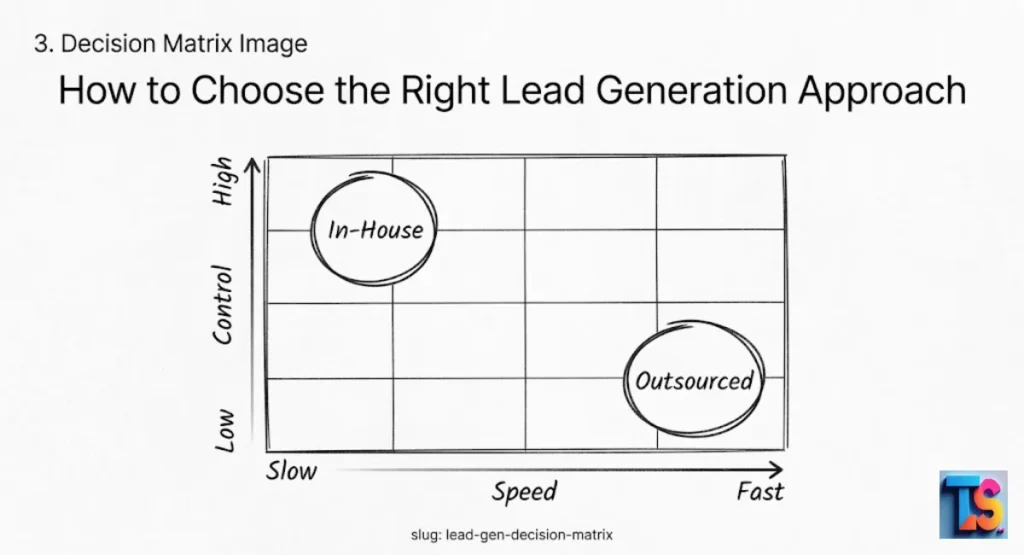
When In-House Makes Sense
How well do you know your market?
Targeting specialized corporate buyer groups requires highly technical product familiarity and customized educational conversations. Internal structures support this deep training style better than general outsourcing groups.
If your target buyers are senior experts who expect deep technical answers, keeping your sales team internal is the smartest path.
If your business operates in a highly technical niche with a small, complex audience, an in-house team is usually best. Complex products require deep technical knowledge that outside agencies struggle to learn quickly.
Can you agree on the definition of a qualified lead?
Maintaining strict control over quality criteria protects your primary sales agents from processing empty, low-value customer meetings. Internal proximity simplifies making fast adjustments to target profiles.
When your setters and closers sit in the same room, they can settle lead quality arguments face-to-face immediately.
Internal alignment is easy when your sales closers and lead generation team work in the same office. If your sales process requires complex qualifying criteria, an internal team can adjust to these strict rules instantly.
Do you have organizational buy-in to sales outsourcing services?
Corporate culture preferences determine whether external business partnerships can survive long-term standard review processes. Leadership must support using external business networks for pipeline creation.
If your executive team demands complete hands-on control over every single client message, an internal team is necessary to avoid friction.
If your executive leadership insists on holding complete control over every customer interaction, outsourcing will cause friction. Internal teams work best when the company culture demands direct, face-to-face management.
When Outsourced Lead Generation Makes Sense
Do you have clear goals for your sales outsourcing project?
Deploying a vendor works best when your enterprise can supply distinct consumer profiles and clean target instructions from day one. Definitive criteria empower external agencies to execute their systems.
When you can point to your ideal buyers clearly, an outside agency can start hunting them down immediately.
If you can point to a specific target market and outline exactly what a good customer looks like, outsourcing works beautifully. Clear goals allow agencies to execute their playbook with precision.
How large is your prospect list?
Processing massive consumer databases requires using broad software capabilities and specialized bulk verification structures. Vendors possess the necessary scale to clean large databases without crashing.
If you have a huge audience to reach, an outside agency can handle that volume without overwhelming your staff.
If you have a massive market with thousands of potential buyers, an outside agency can process that data efficiently. Their enterprise-grade tools allow them to run large-scale campaigns that would overwhelm a small internal team.
Where do you need the most help in your sales strategy and pipeline?
Isolating system bottlenecks helps determine if your primary issue is top-of-funnel booking or bottom-of-funnel closing. Outsourcing unburdens specialized team members from cold-prospecting tasks.
This model lets your top internal experts spend their valuable hours entirely on closing active deals and generating company revenue.
If your main problem is simply getting doors open and booking initial introductory meetings, outsourcing is the ideal solution. It frees up your top internal sales experts to focus entirely on closing deals.
Evaluating Outsourced Partners
Alignment & Company Culture
Confirming brand identity match prevents external agents from distributing conflicting marketing messages into public spaces. Your partner must echo your specific corporate voice accurately.
You must choose an agency that handles your prospects with the same level of care and professionalism that you do.
Look for an agency that matches your professional tone, values, and business ethics. They will represent your brand to the public, so their communication style must mirror your own.
Transparency
A trustworthy partner provides unhindered verification options for your checking teams to review active customer records. Hidden actions introduce unnecessary operational risks.
You need to work with an agency that gives you a full view of their active scripts, campaign numbers, and daily lead logs.
A trustworthy partner gives you full access to campaign data, messaging scripts, and performance analytics. Avoid agencies that hide their specific workflows or mask their metrics behind vague reports.
Security
Verifying a vendor’s modern data security processes protects your firm from costly regulatory privacy mistakes. Your chosen partner must implement strict modern digital protection plans.
They must show you exactly how they protect your data and keep your prospect information safe from modern web leaks.
Ensure the partner follows strict modern data privacy laws and uses secure file-sharing systems. They must protect your company data and your prospects’ personal information from leaks.
The In-House Build: What It Takes
Talent Recruitment and Training: The Hidden Time Cost
Assembling an internal outreach unit consumes valuable leadership hours that would otherwise support key enterprise sales activities. This training burden remains a recurring commitment due to natural employee changes.
Your management must constantly search for new talent to keep your outbound chairs full and productive.
Finding quality sales talent requires writing descriptions, screening hundreds of resumes, and running multiple interview rounds. Once hired, onboarding takes weeks of hands-on training before the worker can speak intelligently with buyers.
This heavy time investment pulls your current managers away from their core revenue-generating tasks.
Technology, Overheads, and Tooling
Managing individual tracking platforms, data scrapers, and dialer configurations introduces substantial financial and technological overhead. These platform fees build a steep monthly operational baseline.
You must purchase separate software licenses for every single hire you bring into your local office space.
Modern lead generation requires a complex collection of software tools. You must purchase CRM access, email verification tools, data enrichment services, and call tracking software.
Managing these separate subscriptions creates technical complexity and adds thousands of dollars to your monthly overhead.
Motivation, Retention, and Productivity
Nurturing outbound cold-calling teams requires significant executive energy to fight standard job fatigue trends. Replacing lost personnel restarts expensive recruitment sequences from zero.
Leaders must spend continuous time building incentives to keep their local staff focused on making hard sales calls daily.
Lead generation is a tough job with high employee burnout rates. Keeping an internal team motivated requires constant management effort, gamified incentives, and clear career paths.
If a key worker leaves, you lose their institutional knowledge and must repeat the expensive hiring loop all over again.
Measuring Success of Your Lead Generation Strategy
Internal Metrics
Monitoring activity logs gives managers deep insights into the regular work ethic and platform productivity of local employees. These indicators point out daily processing numbers.
You use these internal data points to ensure your salaried team is maintaining a consistent amount of effort.
When managing an internal operation, track activity numbers to ensure consistent effort across the team.
- Dials made: The number of outbound phone calls placed daily.
- Emails sent: Total volume of personalized outreach delivered.
- Response rates: The percentage of prospects who answer your messages.
External Metrics
Reviewing third-party performance requires shifting your focus from daily work volumes to net financial pipeline additions. These outcomes show true economic contribution.
You do not need to count how many emails an agency sends; you only need to look at final revenue opportunities.
When evaluating an outside agency, focus entirely on final pipeline outcomes rather than daily activity counts.
- Meetings booked: How many introductory calls are successfully set up.
- Sales qualified leads: Leads that meet your exact buyer criteria.
- Pipeline value: The total potential dollar value added to your sales funnel.
In-House vs Outsourced Lead Generation: Which Model Builds Better Pipeline?
Determining the ideal system depends heavily on your immediate capital access and specific product educational needs. Both channels offer unique benefits for different growth strategies.
Choosing between them requires matching their unique strengths with your current company size, cash availability, and daily pipeline demands.
The model that builds a better pipeline is the one that fits your current operational capacity. Outsourcing builds a pipeline quickly because it uses established networks, clean data, and working infrastructure from day one.
It removes the friction of building a department, making it excellent for expanding into new markets fast.
In-house builds a deeper, highly customized pipeline for complex sales cycles that require months of relationship nurturing.
If your buyers need long-term education and constant touchpoints before buying, an internal team often creates a higher-quality pipeline over time.
The Hybrid Model: Best of Both Worlds?
When should a company consider a hybrid lead generation model?
Combining internal closing expertise with external top-of-funnel collection creates a balanced customer pipeline process. This smart structural choice blends core asset ownership with high-speed operational flexibility.
A helpful hybrid framework lets you keep your best closers focused entirely on hot leads while an outside agency handles all the daily cold outreach and heavy lifting.
The Bottom Line
Pick carefully. Your business needs leads. Sales drive growth. But don’t rush. Take your time. Pick the right path. So build your team. Or hire experts. Just start now. Get moving.