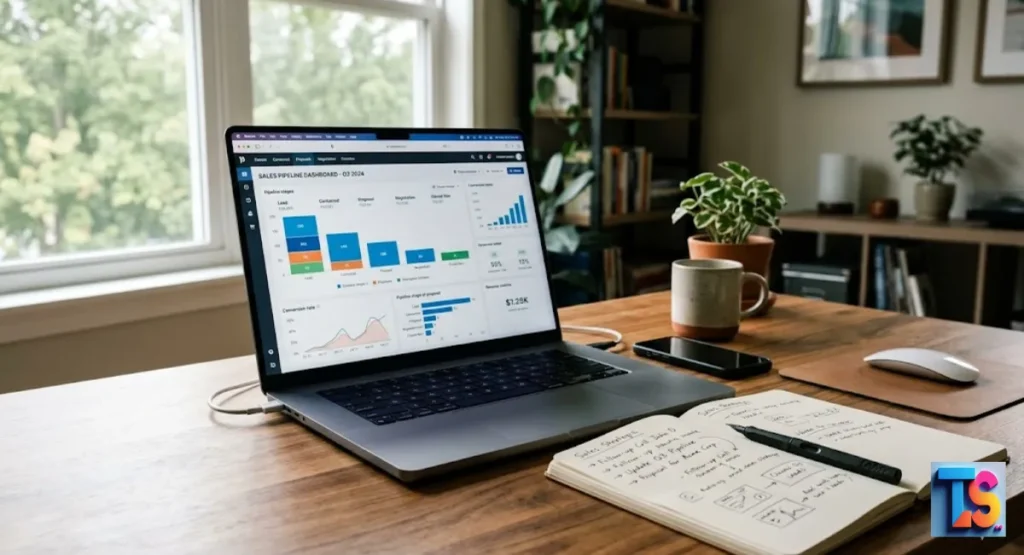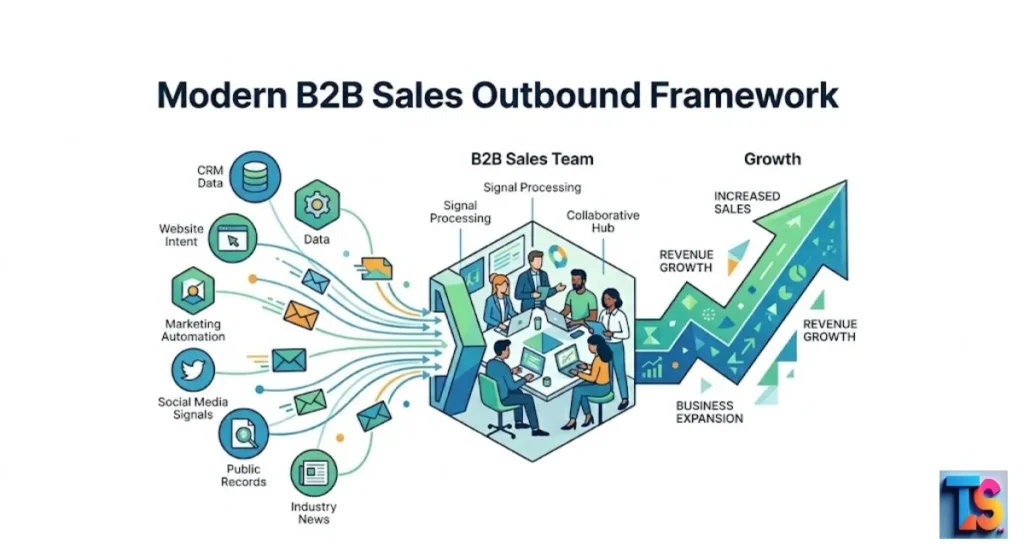
Modern Sales Operations are the foundation of any business that wants to scale quickly in today’s tough market. Building a modern B2B outbound sales department requires a shift from high-volume spam to precision-based engagement.
In today’s market, your success depends on moving beyond generic templates and embracing a data-driven approach that prioritizes high-quality connections over sheer volume.
By aligning your sales operations with real-time intent signals, you ensure your team reaches out only when a prospect is truly ready to buy. This transformation doesn’t just improve your lead generation results; it protects your domain health and builds long-term authority in your niche.
Embracing this strategy allows your team to focus on meaningful customer acquisition while building a scalable revenue operations framework that stands the test of time.
TL;DR: The Modern B2B Outbound Sales Structure at a Glance
To build a great outbound sales team today, focus on smart data instead of just sending many emails. Use a team where some people find good leads, others talk to customers, and some close deals.
By using real-time information, you can improve your sales pipeline and keep your messages from being marked as junk.
Modern outbound sales is no longer about how many emails you send. It is about how relevant your message is to a prospect at a specific moment. Success today relies on a specialized structure where team members focus on deep research and personalized engagement rather than repetitive, automated tasks.
This approach improves your lead conversion and builds a stronger customer journey.
Why the Traditional B2B Outbound Model Failed (And What Changed)
The Death of Volume-Based “Spray and Pray” Automated Sequences
The old way of sending thousands of mass emails no longer works for your business. People ignore generic messages that do not talk about their specific needs.
Today, you must focus on quality over quantity. Sending fewer, highly researched emails ensures your cold outreach strategy gets read and helps you stand out from the competition.
Mass-volume outreach is dead because it no longer produces results. Sending thousands of generic emails daily now results in ignored messages and damaged brand reputation. Buyers demand personalization.
When your outreach feels like a template, prospects ignore it. Modern teams now focus on sending fewer, highly researched messages that address specific business pain points.
New Email Deliverability Rules and the 0.3% Spam Threshold
Email providers now have strict rules to keep inboxes clean. If too many people mark your mail as spam, you will get blocked. Keep your spam rate under 0.3% to reach your audience.
By sending fewer and better emails, you protect your business reputation and ensure your messages always land in the primary inbox.
Major email providers now enforce strict rules to protect users. If your spam complaint rate exceeds 0.3%, your emails go directly to junk folders. This makes the old “spray and pray” method dangerous for your domain health.
Keeping your domain safe requires sending fewer, high-quality emails that prospects actually want to open and answer.
The Shift from Static Lists to Real-Time Intent Signals
Static lists get old very fast because people change jobs and companies grow quickly. Modern sales teams now use real-time signals to find people who are ready to buy.
By watching for signs like new funding or hiring, you can reach out when the customer journey shows they need your help the most.
Static lists become outdated within weeks. Modern teams use real-time intent data to find buyers when they are actually looking for solutions. By tracking events like new funding, leadership changes, or technology shifts, your team reaches out exactly when the prospect needs help.
This timing significantly increases your chances of booking a meeting.
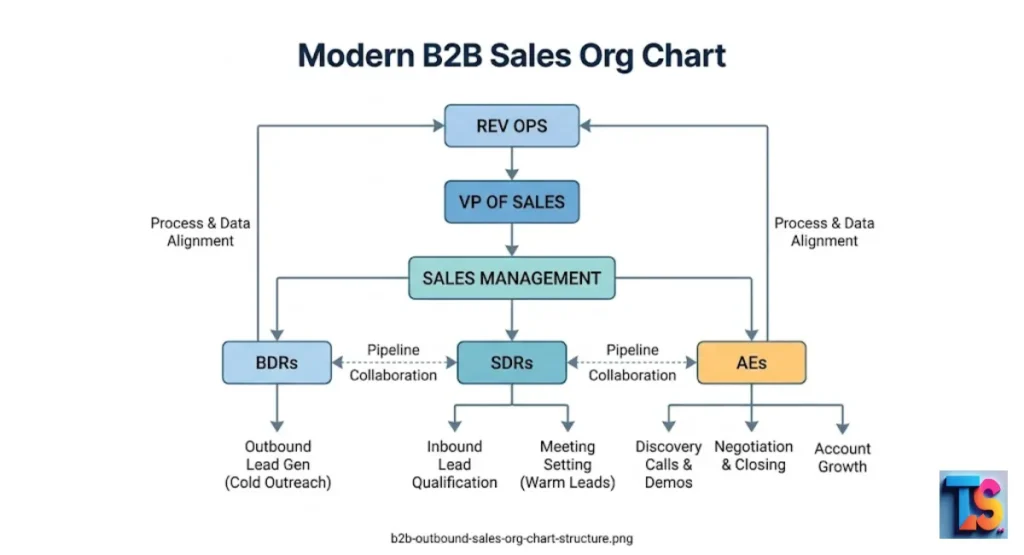
The 2026 Outbound Sales Org Chart: Roles and Specializations
Business Development Representatives (BDRs): The Data and Signal Specialists
BDRs are the experts who find the right people for your sales pipeline. They do not spend time calling; instead, they use data to find high-value leads. By keeping the CRM list clean and accurate, they provide the foundation for the entire team to have successful conversations with potential new customers every day.
BDRs focus exclusively on research and signal analysis. Instead of making calls, they identify the right accounts based on real-time data. They ensure the CRM is clean and that the target list contains only high-probability leads.
By separating research from outreach, you ensure that the rest of your team works with high-quality, actionable intelligence.
Sales Development Representatives (SDRs): The Engagement and Qualification Layer
SDRs are responsible for reaching out and starting real conversations with leads. They take the research from BDRs and turn it into a personal connection. Their goal is to see if a prospect is a good fit and book a meeting.
This is a vital step in moving a lead through the customer journey efficiently.
SDRs handle the actual outreach. They take the insights gathered by BDRs and turn them into personalized conversations. Their goal is to qualify the lead and book a meeting for the Account Executive.
They manage the multi-channel sequence, using phone calls, social media, and email to build a genuine relationship with the potential buyer.
Account Executives (AEs): Seamless Pipeline Hand-Off and Deal Closing
AEs focus on finishing the work of the sales process. They receive leads that are already interested and ready to discuss solutions. Because the earlier steps were handled well, AEs can spend their time closing deals.
A smooth hand-off between team members is critical to keeping the sales pipeline moving forward very quickly today.
The AE receives a qualified lead that has been nurtured and vetted. Because the lead is already interested, the AE spends less time on discovery and more time on closing.
This hand-off process must be smooth, with the AE having full access to all notes and signals captured by the BDR and SDR teams.
Revenue Operations (RevOps): The Technical Infrastructure Backbone
RevOps is the group that makes sure all your tools work together perfectly. They manage the technical side of the sales process, like the CRM and data tools. By keeping the systems running smoothly, they allow the sales team to focus entirely on talking to customers and hitting their monthly goals with ease.
RevOps maintains the tools and processes that keep the team running. They manage the CRM, integrate new data sources, and monitor email deliverability. Their work ensures that the sales team spends time selling instead of fighting with broken software. A strong RevOps foundation is required to scale a modern outbound department.
The Emergence of the Hybrid “Full-Cycle Prospector” for Lean Teams
A full-cycle prospector is a person who does everything from finding the lead to closing the deal. This role is perfect for small companies or new teams. It keeps the sales process simple and fast.
This person gets to see the whole customer journey and learns how to improve their cold outreach strategy quickly.
For smaller teams, the “Full-Cycle Prospector” role combines research and outreach. This person manages their own list-building and prospecting. While this role requires higher skill, it is very efficient for early-stage companies.
It prevents communication gaps between research and engagement, allowing for very rapid testing of new sales messages.
How to Build a Signal-Led Prospecting Engine
Defining Your Ideal Customer Profile (ICP) Beyond Basic Job Titles
Your ideal customer profile is a list of the exact types of companies you can help most. Do not just look at job titles. Look at their real problems and what tools they use.
When you know exactly who you are helping, your messages become much more helpful, and your lead conversion rates increase.
An ICP must go deeper than job titles and company size. Define your target based on their business challenges and current tech stack. Ask yourself: what specific event makes our product a necessity?
When you define your target by their unique situation, your messaging becomes more relevant, and your conversion rates climb.
Tracking 4 Critical Buying Signals: Job Changes, Funding, Tech Stacks, and Hiring Trends
Tracking the right signals helps you know when to reach out. Look for changes in a company that mean they have a new need or a new budget.
This proactive approach ensures you are part of the customer journey when the timing is perfect, rather than bothering people who are not ready.
Focus your efforts on these four indicators:
- Job Changes: A new executive often looks to improve processes.
- Funding: Companies with new capital have a budget to spend.
- Tech Stacks: Target companies already using complementary tools.
- Hiring Trends: A company hiring in specific departments shows a clear need for support.
Data Enrichment: Combining Clay, Apollo, and ZoomInfo for Maximum Accuracy
Using different tools to verify information makes your data more reliable. It is like putting together a puzzle to see the full picture of a company. By having clean and accurate data, your team avoids wasting time on the wrong people and ensures every part of your cold outreach strategy is effective and professional.
Relying on one data source leads to incomplete profiles. Modern teams stack tools to build a 360-degree view of a prospect. Use tools to verify email addresses, uncover technical infrastructure, and track recent company news.
Combining these data points ensures your team reaches out to the right person with a message that resonates.
Designing a Modern Multi-Channel Outreach Cadence
The Blueprint: A Balanced 14-Day LinkedIn, Email, and Phone Sequence
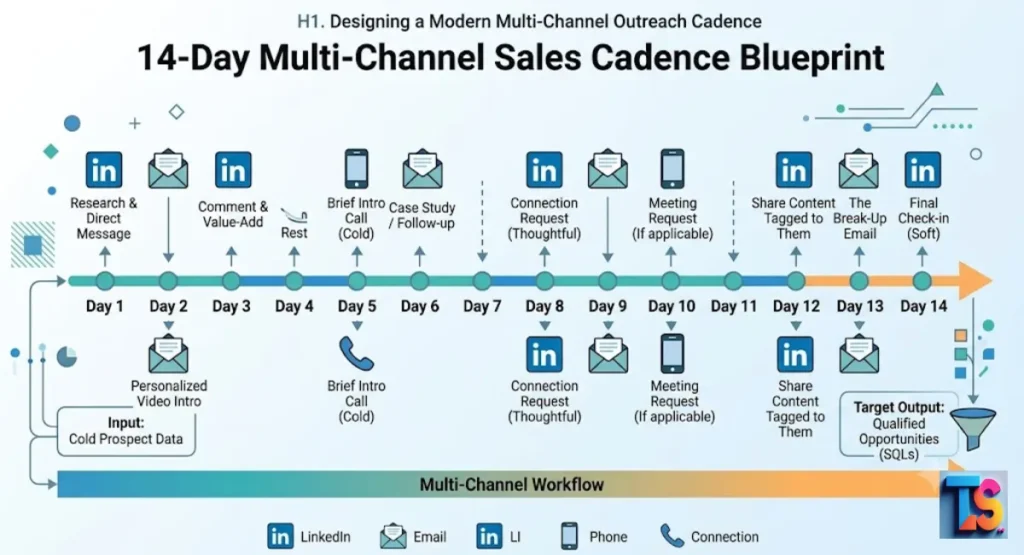
A good sequence uses different ways to talk to a lead over two weeks. By using email, social media, and the phone, you stay helpful and present. This keeps your brand in their mind without being annoying, which is the best way to move someone through the sales pipeline successfully and build trust.
A balanced sequence uses different channels to stay top-of-mind without being annoying:
- Day 1: LinkedIn connection request and personalized email.
- Day 3: Follow-up email referencing a recent company insight.
- Day 6: Phone call to discuss a specific problem.
- Day 10: LinkedIn message sharing a relevant resource.
- Day 14: Final “break-up” email to gauge interest.
Effective alignment between these stages is essential to optimize the B2B sales cycle length.
Writing “Anti-AI” Cold Messages: Brief, Relevant, and Value-First
When you write to a stranger, keep it short and human. Avoid using long or complicated words. Just talk about why you are reaching out and how you can help them.
This makes your message feel like it came from a real person, which is very important for a high-quality cold outreach strategy today.
To write messages that do not look like they came from a robot, keep them short. Focus on the prospect, not your company. Mention a specific signal—like their recent expansion, to prove you did your homework.
If your email is longer than three sentences, it is too long. Provide value, ask one question, and stop.
Maintaining Pristine Domain Health and Inbound Deliverability
You must keep your email domain healthy, so your messages are always delivered. Do not send mail to old or fake addresses. If you send good content to real people, email providers will trust you.
This helps your sales pipeline stay full because your messages actually reach the people you want to talk to.
Protect your domain by warming up new email accounts before sending high-volume outreach. Use automated tools to monitor your spam score and unsubscribe rates daily.
If your emails consistently hit the primary inbox, your response rates will naturally increase. Never send emails to unverified addresses, as this ruins your sender reputation.
The Essential Modern B2B Outbound Tech Stack
Core CRM Infrastructure: Scaling on HubSpot vs. Salesforce
Choosing a CRM is about picking the right tool for your team size. A CRM holds all your customer data in one place. It helps you manage the entire customer journey and keeps your sales pipeline organized.
Pick the one that is easiest for your team to use every single day at work.
| Tool Category | Purpose | Examples |
| CRM | Central Database | HubSpot, Salesforce |
| Data/Intelligence | Prospect Discovery | Apollo, ZoomInfo |
| Data Enrichment | Research & Workflow | Clay |
| Sequencing | Multi-channel Outreach | Outreach.io, Salesloft |
The core of a modern stack is how these systems communicate. When tools integrate flawlessly to handle lead routing, follow-up emails, and activity logging, the direct impact of automation on sales representative productivity allows your team to spend their time selling rather than navigating software.
Choose your CRM based on your team size and technical needs. HubSpot is excellent for smaller to mid-sized teams that need an all-in-one system.
Salesforce is the industry standard for large enterprises requiring custom workflows. The best choice is the one that your team will actually use every day without constant errors.
Sequencing and Personalization Tools That Scale Authentically
Sequencing tools help you stay organized without losing the human touch. They remind you when to follow up and help you keep track of your messages. Use these tools to manage the schedule of your cold outreach strategy, but always write the words yourself so they stay warm, personal, and very effective.
Your sequencing tool should automate the timing of your messages, not the content. The best platforms allow for custom snippets and dynamic fields based on your research.
Use these tools to ensure no lead falls through the cracks, but always review the final output to ensure it sounds human and professional.
Data Hygiene and Verification Software You Cannot Skip
Data hygiene means keeping your contact lists clean and updated. Remove old or wrong information to ensure your emails go to the right people. This saves time and keeps your lead conversion high.
When your data is good, your whole team works much faster and hits your sales targets much more easily today.
Bad data wastes time and hurts your reputation. Use verification tools to check email addresses before sending. Periodically scrub your CRM to remove duplicate contacts and outdated information.
Clean data is the foundation of every successful outbound strategy, as it ensures your team targets active and valid leads.
Key Performance Indicators (KPIs) for Modern Outbound Departments
Outbound Metrics That Matter: Positive Reply Rates vs. Open Rates
Do not worry too much about open rates, as they can be misleading. Instead, look at how many people reply with interest. This positive reply rate tells you if your message is actually good. It is a much better way to see if your cold outreach strategy is helping your sales pipeline grow.
Do not be fooled by open rates. In 2026, focus on Positive Reply Rates to track how many people engage with your value proposition. Furthermore, tracking (KPIs) for sales operations teams is essential to identify bottlenecks in the sales funnel and optimize your infrastructure accordingly.
A high number of positive replies indicates your messaging is relevant and your targeting is accurate.
Setting Realistic Quotas for Meetings Booked and Sales Qualified Leads (SQLs)
Set goals that focus on the quality of your meetings. An SQL is a person who truly needs your help and has the budget to buy. Do not just aim for a high number of meetings.
Focus on meetings that will actually move the customer journey forward and help the team close more.
Set quotas based on the quality of the meeting, not just the volume. An SQL should meet specific criteria, such as having a defined budget and a clear timeline.
If your team books meetings with people who have no intent to buy, you are wasting the AE’s time and lowering your overall conversion rate.
Calculating Your Outbound Customer Acquisition Cost (CAC) and ROI
ROI shows you if your sales efforts are making money. If the cost to get a new customer is higher than the money you make, you need to change your plan.
Tracking these numbers helps you see which parts of your cold outreach strategy work best and where you should spend more time.
To calculate ROI, divide the total cost of your outbound team and tools by the revenue generated from those leads. If your CAC is higher than the lifetime value of the customer, you must refine your targeting.
Successful outbound is a profitable channel that yields a predictable return on investment over time.
Common Mistakes When Restructuring a B2B Outbound Department
Over-Automating Personalization and Burning Target Domains
Using too much technology to write your messages can make them sound cold. People want to talk to real humans, not machines. If your messages sound fake, people will ignore them or mark them as spam.
Keep it personal to build trust and keep your lead conversion rates healthy and very strong indeed.
Using technology to write every sentence makes your outreach generic. When prospects receive identical messages from different companies, they stop trusting all automated outreach.
Use technology to find data, but let your human team write the message. This builds trust and prevents your domain from being flagged as a source of spam.
Misalignment Between Marketing Signals and Sales Outbound Efforts
Marketing and sales must work together like a team. When marketing finds good signals, sales uses them to find leads. If they do not talk, your sales pipeline will have gaps.
Make sure both teams use the same strategy to make the customer journey smooth from the very first contact each time.
If marketing and sales work in silos, you lose efficiency. Marketing should provide the intent signals that sales uses to build their lists. When both departments agree on the target persona and the messaging strategy, your outreach becomes much more effective.
Regular meetings between these teams are necessary to keep everyone focused on the same goals.
FAQs
What is the ideal ratio of BDRs to Account Executives?
The right ratio depends on your deal complexity. A common starting point is two BDRs for every one AE. If your product is complex, you may need more BDRs; for faster sales cycles, one BDR can often support two AEs.
Should you build an in-house outbound team or outsource it?
Build in-house to maintain deep industry knowledge and brand voice. Outsourcing is faster for testing new markets or scaling quickly without training staff. Most successful companies eventually move the process in-house to gain full control over lead quality.
How long does it take for a new outbound sales department to see ROI?
Expect three to six months for consistent results. Use the first month for infrastructure and testing, then look for a predictable flow of meetings by month three. Patience and constant iteration are key to long-term success.