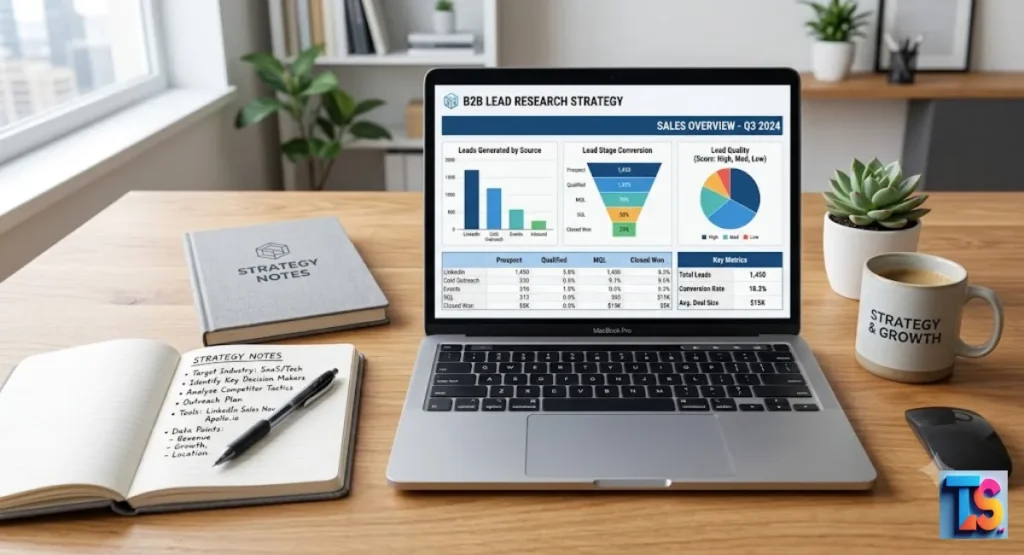
Doing your homework before you reach out is the secret to winning more sales. When you master how B2B lead research impacts conversion rates, you stop chasing cold leads that never buy.
Instead, you focus your energy on people who actually need your help right now. This smart, targeted outreach creates a bridge between your message and the prospect’s real problems. It helps you build trust, keep your CRM data clean, and keep your sales pipeline moving fast.
By skipping the guesswork and using intent data to guide your next move, you turn generic emails into high-value conversations. It is time to work smarter and start hitting your goals consistently.
The Cost of Blind Outreach: Why Volume-First Lead Generation Fails
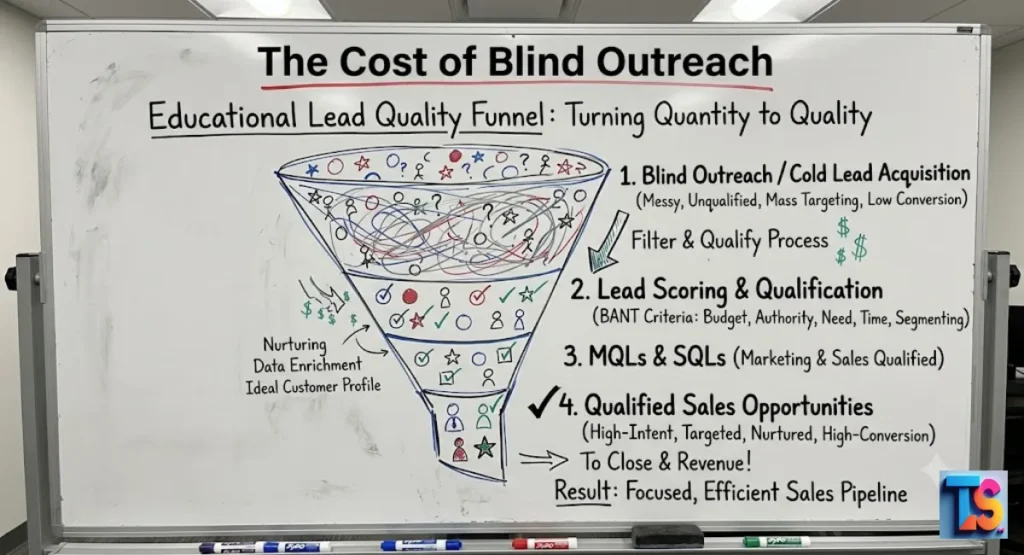
Blind outreach focuses on hitting high numbers rather than high-quality connections. When you contact prospects without doing research, your message lacks relevance.
This approach clogs your system with unqualified leads, lowers your conversion rates, and creates a negative brand reputation in your market, making it harder to secure meetings with decision-makers later on. It hurts.
Volume-driven models ignore the psychological aspect of B2B buying. Prospects today are inundated with generic messaging. When your strategy favors quantity, you inadvertently signal to the market that your solution is a commodity.
This lack of customization forces your team to chase low-probability leads, ultimately resulting in higher customer acquisition costs and diminished brand authority. You lose.
The Hidden Drain on SDR Productivity and Motivation
High-performing teams require efficient workflows. When sales reps waste time on bad data, they face constant rejection. By using research to filter out poor leads, you protect your team’s time.
This allows them to focus on meaningful conversations rather than repetitive, unsuccessful tasks, which keeps morale high and improves overall team output. It helps.
Burnout is often a symptom of poor data, not poor talent. When SDRs spend their day navigating invalid contact information or mismatched leads, their motivation plummets. Implementing a research-first culture shifts their focus toward quality engagement.
Furthermore, prioritizing data hygiene in B2B lead generation ensures that your CRM remains a source of truth rather than a graveyard of outdated information. This empowerment allows them to act as consultants rather than telemarketers, which significantly increases their success rates and long-term career satisfaction. You win.
How Low-Quality Data Destroys Email Domain Deliverability
Maintaining a healthy email reputation is essential for successful outreach. Sending messages to old or incorrect addresses hurts your deliverability. If too many emails bounce, providers will mark your domain as a source of spam.
Good research helps you verify contact information, keeping your domain safe and your messages landing in the inbox. Keep it clean.
Deliverability is the invisible bottleneck of sales. When your technical data hygiene fails, your most persuasive content never hits the target. Internet Service Providers now prioritize engagement signals above all else.
Researching leads ensures that you are only contacting active, relevant recipients, which signals to email filters that your domain is a legitimate, trusted sender. It’s smart.
The Direct Link Between Lead Research and Your Conversion Metrics
Researching leads turns cold outreach into a warm, effective conversation. By understanding who you are talking to, you tailor your value proposition to their specific business needs.
This alignment makes it easier for prospects to see the value you provide, which naturally leads to higher response rates and more successful sales conversions. You grow.
Conversion metrics are essentially a measurement of trust. Research provides the fuel for this trust. When your value proposition maps precisely to a prospect’s current initiatives, the barrier to entry dissolves. This strategic alignment turns skeptical buyers into interested partners, as your messaging proves that you have invested time in understanding their unique business challenges.
By integrating predictive lead scoring into your strategy, you can mathematically identify which of these prospects are most ready to engage, further maximizing the efficiency of your research efforts. It works.
Bridging the Leak: Improving MQL to SQL Conversion Rates by 30%
Context is the missing link between lead generation and sales success. By using research to enrich your leads, you give your team the information they need to close.
This added context helps you identify the best opportunities, allowing you to convert more marketing leads into qualified sales leads with significantly less wasted effort. It’s simple.
Lead leaks usually occur during the handover phase. Marketing teams generate volume, but sales teams often reject it due to a lack of specificity. By enriching these leads with deep research, you provide the missing context that allows sales to act immediately.
This synergy closes the funnel gap, ensuring every marketing dollar spent leads to a high-intent conversation. You gain.
Shortening the Sales Cycle Through Predictive Prioritization
Predictive scoring helps your team know exactly who to call and when. Instead of guessing, you use data to find the leads most likely to buy. This focus on high-intent prospects removes delays and allows your team to move through the sales process much faster, from the first call to the final contract. Speed wins.
Velocity is the byproduct of prioritization. When you use predictive data, you stop wasting energy on the top of the funnel that is not ready. Instead, you create a direct path to the decision-makers currently evaluating vendors.
This strategic focus accelerates the consensus-building process, effectively shaving weeks off the typical B2B sales cycle. You save.
Increasing Demo Show-Up Rates with Pre-Call Intelligence
Prospects value their time, and they want to know that a meeting will be useful. When you share a pre-call agenda based on your research, you show that you understand their unique challenges.
This simple step builds trust, sets clear expectations, and leads to significantly higher show-up rates for your sales demos. They show.
A demo is a commitment of time and attention. When a prospect agrees to meet, they need confirmation that the effort will pay off. Pre-call intelligence acts as a validation of that commitment.
By demonstrating that you have done the homework, you move the demo from a generic product presentation to a tailored problem-solving session. You close.
The Three Pillars of High-Converting B2B Lead Vetting
Building a successful pipeline requires a structured strategy based on Data-Driven B2B Intelligence. By focusing on intent, technology, and organizational structure, you create a solid foundation for your outreach.
This multi-layered approach ensures your team targets only the best accounts, which makes your entire sales process more efficient and highly effective. Build it.
Vetting is not just about filtering; it is about strategic selection. By categorizing leads based on intent signals, technographic fit, and DMU hierarchy, you eliminate guesswork.
This structured pillar strategy ensures that every lead passing into your CRM is primed for engagement, which maintains the integrity of your pipeline and drives higher conversion rates. It’s fixed.
| Feature | Traditional Lead Research | 2026 AI-Driven Lead Research |
| Data Depth | Basic firmographics only | Technographic and intent signals |
| Workflow | Manual search and entry | Automated data enrichment |
| Timing | Static list-based outreach | Real-time active buying window |
| Focus | Volume and broad reach | Precision and personalization |
Advanced ICP Mapping (Going Beyond Basic Firmographics)
Basic firmographics like size are not enough to find the best leads. You need a deeper view of what makes a company a good fit. By looking at growth phases and leadership changes, you can find accounts that truly need your help now.
This advanced approach makes your outreach more timely and much more relevant. Stay sharp.
True ICP mapping requires an analysis of current organizational stressors. Leaders change, budgets shift, and priorities rotate. Advanced mapping looks for the catalysts of change.
By focusing on triggers such as recent rounds of funding or massive hiring spikes, you identify the exact moment an account transitions from a passive observer to an active buyer. You win.
Intent Data Activation: Timing Your Outreach to the Active Buying Window
Timing is everything in sales. Intent data shows you which companies are actively looking for solutions right now. By paying attention to signals like website visits, you can reach out when you are most likely to get a response.
This proactive strategy ensures your brand is there when the customer is ready. Start now.
Activation is the bridge between observation and revenue. Monitoring signals is only useful if you act before the competition. By establishing automated triggers based on intent, you ensure that your sales team is the first to arrive when the prospect starts their research, effectively shaping their evaluation criteria before they ever contact another vendor. You lead.
Technographic Tracking: Aligning with the Prospect’s Existing Software Stack
Understanding the tools a company already uses changes how you sell. When you know their software stack, you can show exactly how your solution fits their existing environment.
This level of technical alignment builds immediate authority and trust, making it clear that your product is a perfect match for their specific technical needs. It fits.
Technographic data is a shortcut to technical credibility. Every software stack has its own set of dependencies and integration challenges. By demonstrating that your solution integrates seamlessly with their current tools, you remove the fear of technical debt.
This alignment proves that you are a partner, not just a service provider, which simplifies the decision for IT stakeholders. You connect.
Actionable Framework: The 3-Minute Pre-Outreach Research Workflow

Efficiency allows your team to maintain high volume without losing quality. You can gather enough information to personalize your approach in just three minutes.
By following this standard, three-step process, you ensure that every member of your sales team provides a high-quality, personal, and effective experience for every prospect they reach out to. Do it.
Standardization creates scalability. When your team follows a strict, time-bound workflow, you eliminate research procrastination and ensure consistency across the pipeline.
This framework forces reps to look for high-value data points quickly, which prevents them from getting stuck in an endless loop of minor, irrelevant details that do not drive revenue. Stay fast.
Step 1: Identifying the Decision-Making Unit (DMU)
Decisions in B2B are rarely made by just one person. You must identify everyone involved, including users, influencers, and buyers. By understanding the full unit, you can tailor your message to address the specific needs of each person.
This helps you build consensus and move the deal forward much faster than focusing on one person. Map them.
DMU mapping is about identifying stakeholders at different levels of power and influence. You have the economic buyer who holds the budget, the champion who advocates for you, and the technical influencer who critiques your security or integration.
A successful strategy requires a custom narrative for each role to ensure you have advocates across the entire organization. It’s key.
Step 2: Uncovering “Hook” Triggers via LinkedIn and Company News
A good hook gives you a clear reason to connect. By mentioning a recent event, such as a new hire or an award, you prove that you have done your research.
This simple act transforms a cold outreach message into a timely, relevant conversation that is much more likely to get a positive response. Connect well.
Triggers are the antidote to the “we were just in the neighborhood” sales email. A real hook ties your product value to a specific company event.
When you link your solution to a recent product launch or internal restructuring, you move the conversation from “why should I buy” to “how can you help us handle this specific development.” It works.
Step 3: Auto-Enrichment vs. Manual Vetting (Finding the Right Balance)
Balancing technology and human effort is the key to scaling your research. Use tools for the basic data, but keep manual work for the insights that really matter.
This mix ensures your outreach is both efficient and personal, giving you the best chance to build a real relationship with your future customers. Balance it.
Automation should handle the baseline, not the relationship. Use enrichment to secure phone numbers, titles, and software data. Reserve the human element for synthesizing those facts into a coherent, empathetic message.
This balance protects your team from manual labor while ensuring the final communication carries the necessary human touch to distinguish your brand from automated bot traffic. It’s best.
| Method | Best Use Case | Benefit |
| Auto-Enrichment | Contact details, firmographics | High speed and scalability |
| Manual Vetting | Personal hooks, strategy | High relevance and connection |
Personalization vs. Customization: Before-and-After Outreach Examples
Personalization goes beyond just using a prospect’s name in an email. True customization requires connecting your value to their specific situation. This difference determines if your message is treated as helpful insight or just another piece of spam.
Always aim to show that you understand their unique challenges and can offer a real solution. Customizing wins.
Personalization is a database entry. Customization is a strategic narrative. Most automated platforms can handle personalization, but customization requires a deep understanding of the prospect’s business context.
By focusing on customization, you elevate your brand to the status of a strategic partner, significantly increasing the likelihood of securing an executive-level conversation. You rise.
The Generic Template That Fails to Convert
Hi [Name], I saw you work at [Company]. We help businesses like yours improve efficiency. Are you available for a quick call to see how we can help?
This message fails because it is about the sender. It offers no value, shows no research, and ignores the recipient’s actual business needs. It dies.
The Research-Backed Message That Commands a Response
Hi [Name], I noticed your team recently launched [Project] at [Company]. Given your focus on [Goal], I imagine integrating [Tool] might be a priority to reduce manual work. We helped [Competitor/Peer] save 10 hours a week on this. Are you open to seeing the workflow we used?
This message succeeds because it demonstrates detailed research and offers specific value. You get it.
Beyond Form Friction: Driving Conversions via Real-Time Data Enrichment
The way you collect data on your website impacts your conversion rates. Long, complicated forms stop prospects from completing their requests. By using backend data enrichment, you can capture the information you need while keeping the user experience simple, fast, and professional for every single visitor. Make it easy.
Forms are the final hurdle in your lead generation strategy. Every field added is an invitation for the prospect to abandon the journey. By offloading data collection to backend enrichment, you turn your forms into frictionless gateways.
This approach ensures you capture high-quality intelligence without ever burdening the user with intrusive or unnecessary input requirements. You win.
Why Short Forms with Backend Enrichment Outperform 10-Field Forms
A simple form is a better form. If you only ask for an email address, you make it easy for your visitors to connect with you. Backend tools then fill in the rest of the profile.
This reduces friction, increases your conversion rate, and gives your sales team higher-quality data to work with. It’s clean.
Short forms minimize cognitive load. When users feel they are investing minimal effort to get maximum value, conversion rates climb. By integrating enrichment, you collect data during the submission process rather than the input process.
This maintains the user’s momentum and provides your team with a complete profile, including job role and company size, without requiring an exhaustive form. You grow.
Metrics to Watch: Tracking the True ROI of Your Research Strategy
Success requires looking at metrics that truly show the impact of your work. You need to track data that connects your research to your bottom line.
By monitoring how quickly leads become deals and how often they convert, you can clearly prove the financial value of your research-driven sales strategy to your team. Do it.
Effective management is data-informed management. If you only track the number of leads, you are ignoring the quality of your pipeline. High-velocity pipelines and high win rates are the ultimate test of your research strategy.
These metrics prove that you have successfully identified and engaged the right market, which justifies every dollar invested in research and automation. You lead.
| Key Metric | Definition | Why It Matters |
| Pipeline Velocity | Speed from lead to deal | Shows efficiency and revenue growth |
| Win Rate | Percentage of won opportunities | Proves lead quality and research value |
Shifting from Cost-Per-Lead (CPL) to Pipeline Velocity
CPL is only a start, not the end goal. Pipeline velocity is much more important for revenue. It measures how fast a lead becomes a closed deal. When you focus on velocity, you bring money into the business faster.
Research helps you identify the best leads so your team spends its time effectively. Speed is king.
Velocity captures the time-value of money in sales. A cheap lead that takes six months to close is far less valuable than a slightly more expensive lead that closes in three weeks.
By prioritizing research, you ensure your team targets high-velocity prospects, which shortens your feedback loops and allows you to optimize your strategy based on real revenue outcomes. You win.
Measuring Account-to-Opportunity Win Rates
Your win rate is the best way to check if your research is working. If you win more deals, your research is likely identifying the right prospects. If win rates are low, you may need to adjust your targeting.
High win rates confirm that you are successfully finding and converting the right companies. Check it.
Win rate is the final verdict on lead quality. If your marketing and sales efforts are perfectly aligned, win rates remain high. If you notice a decline, it indicates that your research criteria have drifted from the ideal customer profile.
Continuous monitoring of this metric ensures that your research strategy evolves alongside the changing needs of your market. It’s real.
FAQs
How much time should an SDR spend researching a single lead?
An SDR should spend no more than three to five minutes per lead. The goal is to find one or two meaningful “hooks” to customize the outreach. If research takes longer, it becomes inefficient. Use automated tools for data gathering so you can focus your time on high-value qualitative research. Stay fast.
What are the best tools for automated B2B lead data enrichment?
There are many tools available in 2026, including platforms like Apollo, Clearbit, and ZoomInfo. These tools integrate with your CRM to automatically update prospect data. Select tools that offer the highest accuracy and the best integration with your current technology stack to ensure your data stays clean and usable. Choose well.
How do you prevent lead research data from decaying in your CRM?
Data decay happens quickly as people change jobs or companies. Schedule regular clean-up sessions and use automated verification tools to check your database every month. Removing invalid records and refreshing contact details keeps your pipeline healthy and prevents your email marketing from being blocked by internet service providers. The bottom line is, keep it clean.