In 2026, Data-Driven B2B Intelligence is the secret weapon for businesses that want to grow fast. If you are tired of guessing which prospects will actually buy, it is time to upgrade your strategy. Predictive lead scoring:
What it is and how it works involves using smart software to analyze historical patterns and rank new leads by their true buying potential. By focusing on your ideal buyer persona, you can stop wasting time on dead ends and start closing more deals.
Good data hygiene is essential here, as it ensures your AI models have clean, accurate info to drive your conversion rate impact higher and accelerate your overall B2B sales pipeline performance.
What is Predictive Lead Scoring? (The Modern Definition)
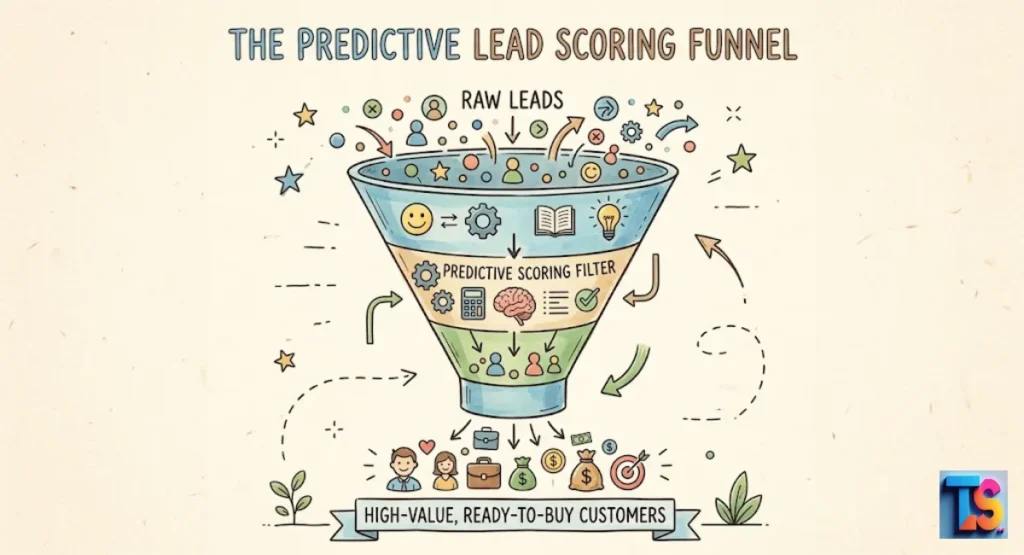
Predictive lead scoring is a smart tool that uses software to rank your leads based on how likely they are to buy. By looking at past sales, the system finds patterns that show which people are ready to purchase now.
This process improves your data hygiene, which leads to a major conversion rate impact.
This process moves beyond simple manual rules. It is precise. Instead of giving points for a single website click, the system looks at thousands of data points at once.
It identifies the “DNA” of your best customers. By doing this, it removes the guesswork from your sales process and ensures your team spends their time on high-value opportunities that actually result in revenue.
Traditional vs. Predictive Lead Scoring: Why the Point System is Dead
Traditional scoring relies on old, manual rules. But this often fails to track how B2B lead research impacts conversion rates. Predictive scoring uses real data from your past wins to show true intent.
This helps your team improve pipeline velocity, which means leads move through your sales funnel much faster. Good data hygiene makes this system work even better. It is crucial.
- Traditional Scoring: Static, manual, and often based on vanity metrics (numbers that look good but do not mean sales).
- Predictive Scoring: Dynamic, automated, and based on real-world outcomes from your CRM (the database where you store customer info).
While traditional scoring stays the same until a human changes it, predictive models learn and evolve. As your market changes in 2026, the model updates itself to reflect new buyer behaviors.
This keeps your sales team focused on the most relevant prospects at all times.
Under the Hood: The 3 Core Data Pillars AI Analyzes
Firmographic and Demographic Fit (The “Who”)
This pillar looks at the profile of the company and the person involved to judge value. It analyzes key details like industry type, company size, yearly revenue, and specific job titles.
By checking these facts against your ideal buyer persona, the system quickly sees if a new lead matches your best customers from the past.
This is the foundation of lead qualification. When the AI compares new leads to your historical successes, it ensures that your sales team is not wasting time on companies that do not fit your business model.
It creates a clear path for revenue growth by filtering out low-quality prospects before they even reach a human.
Behavioral and First-Party Intent Data (The “What”)
This pillar tracks how a lead interacts with your business across different channels. It records website visits, whitepaper downloads, and webinar attendance.
Modern tools focus heavily on first-party data, which is info you collect yourself. This is the most reliable way to gauge true interest and understand what a lead really wants today.
First-party data provides a high-fidelity view of the buyer journey. By monitoring these specific actions, the system assigns higher scores to leads who show active intent.
This information is vital for sales-marketing alignment, as it allows your team to reach out with the right message at the exact moment the lead is ready.
Negative Signals that Drop Scores (The “Deal Breakers”)
Not all actions are positive for your sales goals. The system also tracks specific behaviors that suggest a lead is not a good fit for your products.
If a lead visits your careers page to look for a job, or if their email address comes from a free or suspicious domain, the model lowers their score. It acts fast.
This feature protects your team from wasting time on dead ends. By identifying these negative signals early, the software ensures that your sales representatives stay focused on high-value leads.
It keeps your pipeline clean and ensures that your conversion rate impact remains high by removing noise from the data.
Step-by-Step Implementation Framework: Going from Messy CRM Data to AI Efficiency
Phase 1: Assessing Data Maturity (Do you have at least 100+ closed-won deals?)
Predictive models need a history of success to work well for your business. If you have fewer than 100 closed-won deals, the AI lacks enough data for patterns.
To get the best results, ensure your the importance of data hygiene in B2B lead generation. This maturity is key to better lead qualification, higher conversion rate impact, and better sales conversations.
Building a predictive system requires a solid foundation of historical data. If your data is incomplete or disorganized, the AI will struggle to find meaningful trends.
By verifying that you have a sufficient volume of past wins, you prepare your CRM for the model to effectively learn what a successful buyer looks like.
Phase 2: Cleaning the Pipelines and Mapping the Custom Fields
Your AI is only as good as the info it receives from your team. Clean your CRM by removing duplicate contacts and fixing outdated company info. Map your custom fields, which are specific categories for your data, so the AI knows exactly what “Job Title” or “Industry” means across your entire database for accurate tracking.
Clean data is the engine of high-performance lead research. When fields are mapped correctly, the AI can cross-reference information seamlessly.
This preparation prevents errors in lead scoring and ensures that the model operates with the highest degree of accuracy, which is necessary for maintaining a predictable and steady B2B sales pipeline.
Phase 3: Setting Up Your CRM Tool (HubSpot, Salesforce, or Dynamics 365)
Most major CRMs now have built-in predictive features ready for use. Connect your data sources to these tools through proper CRM integration. Start with a small pilot program to test the scores against your current lead list before rolling it out to the entire department.
This ensures the system works perfectly for your business needs.
Integrating predictive tools directly into your existing CRM environment minimizes disruption for your team. By running a pilot program, you can validate the scoring logic against real-world results.
This step-by-step approach allows you to adjust settings and ensure that the scoring output aligns with the actual quality of leads currently entering your pipeline.
Phase 4: Defining the SLA (Sales-Marketing Alignment Rules)

Create a clear agreement on what a score means for your teams. This is called sales-marketing alignment. For example, agree that any lead with a high score must be called by sales within four hours.
This rule ensures that both teams work toward the same revenue goals and do not let good leads sit cold. They must align.
An effective Service Level Agreement (SLA) turns data into action. When marketing and sales agree on the criteria for high-scoring leads, the hand-off becomes automated and efficient.
This alignment is critical for maximizing your conversion rate impact and ensuring that no qualified prospect is left behind due to slow or uncoordinated follow-up.
Head-to-Head: Choosing Your Predictive Lead Scoring Tech Stack
| Platform Type | Best For | Notable Examples |
| Built-In Tools | Teams already using a major CRM | HubSpot, Salesforce Einstein |
| Enterprise Solutions | Companies needing advanced intent data | 6sense, Demandbase, ZoomInfo |
Best Built-In Platform Tools (HubSpot vs. Salesforce Einstein)
If you already use HubSpot or Salesforce, start here for the best results. These tools are designed to work directly with your existing CRM data. They are easy to set up and provide enough power for mid-sized businesses to see immediate improvements in lead quality.
They keep your data in one place for a smooth workflow. It is simple.
Built-in tools are often the most cost-effective way to get started with predictive intelligence. Because they are native to your CRM, you avoid complex integration challenges.
These platforms are ideal for teams that want to improve their lead qualification process quickly without needing to manage multiple disconnected software subscriptions or external data sources.
Best Enterprise Third-Party Solutions (6sense, Demandbase, ZoomInfo)
Large organizations often need more than just internal CRM data to win. These platforms bring in external market data and deep intent signals from across the web. They are best for complex B2B sales where you need to track buying groups instead of just individual leads to help your team win larger deals more often. It helps growth.
Third-party solutions offer a wider view of the market by capturing intent signals that happen outside your own website. For complex B2B sales cycles, these insights are invaluable.
They help your sales team identify hidden opportunities within a buying group, providing a significant advantage in competitive markets where timely outreach is everything.
The Hidden Realities: Why Predictive Lead Scoring Fails (And How to Prevent It)
The “Garbage In, Garbage Out” CRM Trap
If your CRM data is incomplete, the AI will make bad predictions for you. Before launching, perform a full audit, which is a deep check of your lead database.
Ensure that your sales team is actually entering data after their calls. Good data leads to better scores, while bad data leads to poor results. Just clean data.
The success of any predictive model depends entirely on the quality of the underlying data. If your team does not maintain accurate records, the AI will learn from faulty inputs, leading to inaccurate scores.
Regular data audits are essential to ensure that the system remains a reliable partner for your sales and marketing efforts.
The Black Box Problem (Why sales reps ignore scores they don’t understand)
Sales reps will not trust a score if they do not know why it was assigned. Choose a tool that explains the “why” behind the score.
If a rep sees that a lead has a high score because of specific intent signals, they are more likely to act on it with confidence and speed. It builds trust.
Transparency is the key to user adoption. When reps understand the logic behind a score, they can tailor their outreach strategy effectively.
A “black box” system that provides scores without explanation often results in low adoption, as sales teams will naturally revert to their own manual methods instead of trusting an opaque AI.
Algorithmic Drift (Why you must retrain the model every quarter)
Market trends change every few months in the fast-paced B2B world. A model that worked in early 2026 might be outdated by the end of the year. Retrain your AI model every quarter to ensure it recognizes new buying behaviors and market shifts.
Keeping the model fresh is vital to maintaining high conversion rates. Do it often.
Algorithmic drift happens when the real-world environment changes faster than the AI model. If you do not retrain the model, it will continue to score leads based on old data, causing performance to drop.
Quarterly updates ensure that your scoring system stays synchronized with current market dynamics and continues to deliver highly accurate results.
FAQs
How many leads do you need for predictive lead scoring to work?
You generally need at least 100 closed-won deals to build a baseline. Without this historical data, the machine learning model lacks the foundation to identify what makes a high-quality lead for your specific business. This ensures the AI can accurately tell the difference between a real buyer and a random website visitor.
What is the difference between predictive and descriptive analytics?
Descriptive analytics explains what happened in the past, like how many leads you generated last month. Predictive analytics uses that history to forecast what will happen in the future, identifying which current leads are most likely to buy. It turns your past data into a roadmap for your future success. It works well.
Can you use predictive lead scoring for outbound sales pipelines?
Yes. By using external data, you can score prospects you have not yet contacted. This helps your outbound team prioritize their cold outreach, allowing them to focus on companies that match the profile of your best customers.
This strategy makes your team much more efficient at reaching the right people.
The bottom line is that predictive lead scoring is a powerful tool to sharpen your B2B lead generation efforts. By focusing on data hygiene, choosing the right tech stack, and constantly retraining your models, you can turn your CRM into a revenue-generating machine.
Start small. Ensure your data is clean. Align your teams to see the best results. You will grow.