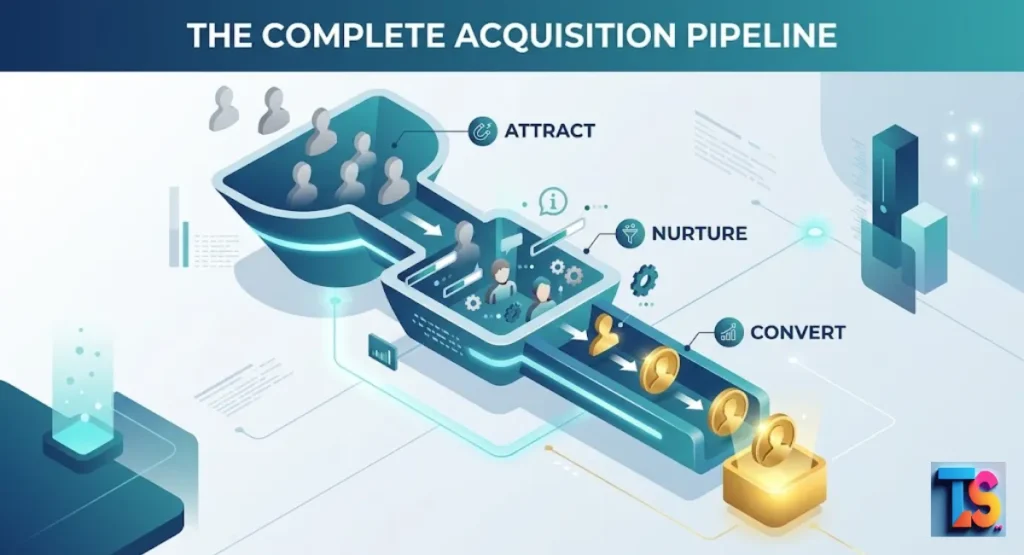
Client acquisition is the essential process of finding and winning new business buyers. For any growing company, setting up a predictable sales funnel is the only way to escape unpredictable income cycles and protect against unexpected market shifts. This structured journey takes a person from being a complete stranger to a loyal, paying account by combining targeted marketing with clear communication.
Instead of relying on random luck, successful business owners use a reliable marketing strategy to keep their pipeline full. By understanding how to calculate your average customer acquisition cost, you can scale your revenue safely and build a highly profitable lead generation system that works automatically.
What Is Client Acquisition?
Client acquisition is the process of bringing new customers or clients to your business. It involves a strategic set of actions that takes a person from completely unaware of your company to a paying customer. The goal is to create a repeatable, measurable process that consistently converts prospects into buyers.
This process is not just about sales calls. It combines marketing, data analysis, and relationship building. A healthy acquisition strategy relies on multiple channels to ensure your pipeline stays full, regardless of market shifts.
Why a Structured Acquisition System Matters for Modern Businesses
A random approach to finding clients creates unpredictable revenue cycles. Businesses often experience a feast-or-famine cycle where they focus heavily on sales, get busy with fulfillment, and stop looking for new business until the current work dries up.
Setting up a corporate plan helps you build a permanent client acquisition system to remove this instability. By setting up predictable pathways for new leads, you build regular monthly growth. This structured approach lets you forecast future revenue, hire staff confidently, and invest back into your operations with minimal risk.
Customer Acquisition vs. Retention: Balancing the Growth Equation
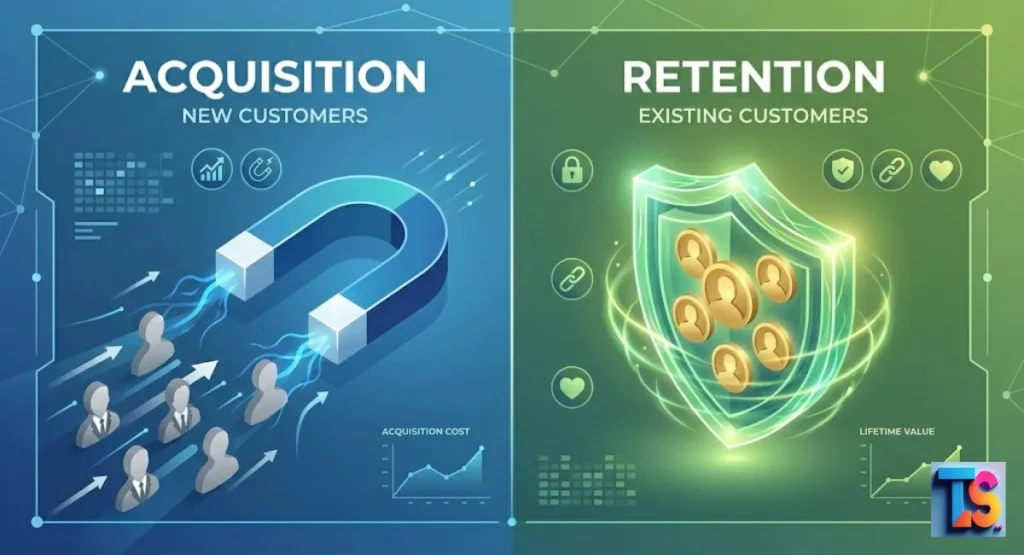
Key Differences Between Acquiring and Retaining Customers
Acquisition focuses on the beginning of the customer journey, while retention focuses on the end. Acquisition requires you to convince a stranger to trust you with their money for the first time. Retention requires you to keep delivering enough value that an existing customer continues to pay you.
| Feature | Client Acquisition | Client Retention |
| Primary Goal | Win new logos and market share | Maximize account value and loyalty |
| Audience | Prospects and cold audiences | Existing buyers and active users |
| Primary Tools | Advertising, cold outreach, online search | Customer service, loyalty programs, updates |
| Effort Level | High (building trust from scratch) | Medium (maintaining established trust) |
The Cost Factor: Acquisition Cost (CAC) vs. Lifetime Value (LTV)
Winning a new customer is significantly more expensive than keeping an old one. To understand your business health, you must balance your Customer Acquisition Cost (CAC) against your Customer Lifetime Value (LTV).
- Customer Acquisition Cost (CAC): The total money spent on sales and marketing to win a single new customer.
- Customer Lifetime Value (LTV): The total gross profit a single customer generates for your company over the entire duration of your relationship.
A healthy business model requires an LTV that is at least three times higher than its CAC. If your acquisition costs are too close to your lifetime value, your business will run out of cash, even if you are winning plenty of new accounts. Carefully balancing your customer acquisition vs retention ensures you do not waste money on a leaking bucket, a concept backed by growth studies from Harvard Business School Faculty & Research.
The Core Framework: How a Modern Client Acquisition Engine Works
Stage 1: Lead Generation & Attracting Prospects
The first phase of the acquisition engine is about capturing attention. You must identify your ideal buyers and present them with a compelling reason to engage with your brand. This requires clean market research and data targeting.
To attract high-quality leads, companies use magnets like industry reports, free software tools, or educational webinars. The goal of this stage is simply to exchange helpful information for a prospect’s contact details, moving them from a nameless visitor to an active lead.
Stage 2: Lead Nurturing & Building Trust
Once a lead enters your system, they are rarely ready to buy immediately. Lead nurturing is the deliberate process of educational communication that moves a prospect down the sales funnel.
During this stage, you share case studies, social proof, and deep-dive answers to their specific industry problems. This builds your authority and answers their silent objections before they ever book a sales call.
Stage 3: Conversion & Closing the Deal
Conversion is the final step where a qualified lead becomes an official client. This stage involves product demonstrations, custom proposals, contract negotiations, and handling final price objections.
A clean conversion process relies on clear pricing, simple contracts, and an easy and smooth setup for new clients. The smoother you make this transition, the less likely you are to lose buyers at the finish line.
The Role of Automation: Scaling with a Client Acquisition Bot
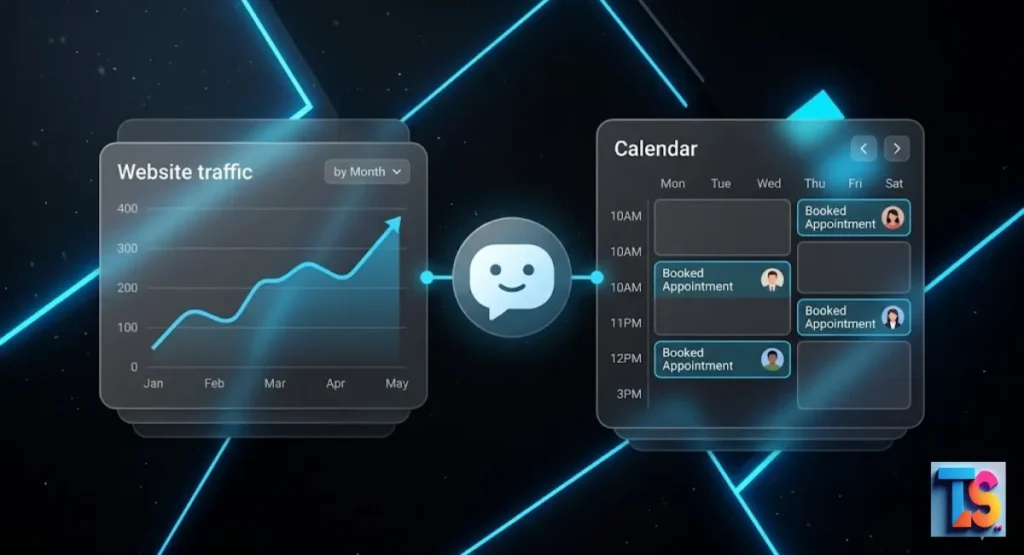
Handling every single initial touchpoint manually limits how fast your company can scale. Modern businesses use an automated client acquisition bot to handle early-stage chats, instantly reply to website visitors, and schedule calendar appointments for sales reps.
[Web Traffic] ➔ [Acquisition Bot Chat] ➔ [Instant Qualification] / [Calendar Booking]
This software uses logical workflows to screen out bad fits without wasting human sales hours. By instantly greeting prospects who land on your site, you capture intent when it is highest, ensuring no hot lead cools down due to slow human response times.
Best Strategies for Client Acquisition Across Different Channels
Inbound Channels: Content Marketing, Organic Search, and Online Visibility
Inbound acquisition happens when customers find your business on their own, a process driven by what Harvard Business School Online calls deep consumer engagement. By publishing authoritative articles, detailed guides, and answers to industry questions, you earn visibility on modern search platforms and smart answer engines.
This channel offers the highest long-term return on investment. While paid ads stop working the moment you stop paying, an organic piece of search content can attract qualified business leads for years after it is published.
Outbound Channels: Cold Outreach and Direct Networking
Outbound acquisition involves reaching out directly to specific individuals who fit your ideal buyer persona. This includes personalized email campaigns, cold calling, social selling, and attending physical industry conferences.
Outbound works best when it is highly targeted. Instead of blast-emailing thousands of generic addresses, research a tight list of premium accounts and craft custom messages that address their exact corporate challenges.
Paid Channels: PPC and Social Media Advertising
Paid acquisition gives you immediate traffic and predictable control over your lead volume. Pay-Per-Click (PPC) ads on search networks target users who are actively searching for a vendor, giving you access to high-intent buyers.
Social media ads allow you to target prospects based on job titles, industries, company sizes, and specific professional interests. To win using the best strategies for client acquisition, combine paid channels with organic ones for long-term cost stability.
B2B Client Acquisition: Navigating Account-Based Growth
How B2B Acquisition Differs from B2C
Business-to-Business (B2B) sales cycles are fundamentally different from Business-to-Consumer (B2C) sales. B2C purchases are often emotional, fast, and decided by a single person. B2B purchases are strictly rational, expensive, and require multiple layers of approval.
In B2B growth, you are rarely selling to an individual. You are selling to an entire corporation. The messaging must focus heavily on return on investment, operational efficiency, and reducing danger or protecting against loss rather than personal lifestyle benefits.
Navigating Long Sales Cycles and Decision-Making Committees
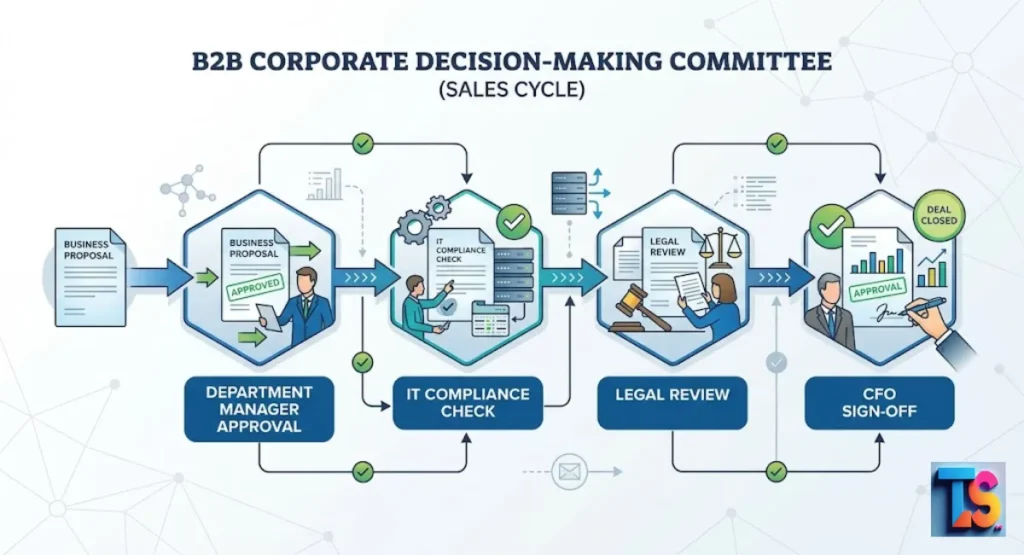
A typical enterprise B2B deal can take months to finalize. During this window, you must manage a buying committee that includes the company buyers and decision-makers from the purchasing team, legal, IT, and executive leadership.
[Department Manager] ➔ [IT Compliance] ➔ [Legal Review] ➔ [CFO Approval]
To close these deals, you must create distinct assets for each stakeholder. The IT manager needs security documentation, the user needs feature walkthroughs, and the CFO needs a clear cost-benefit breakdown. Navigating a successful b2b client acquisition plan means keeping everyone aligned throughout a long sales window.
Industry-Specific Acquisition Playbooks
High-Trust Niches: Client Acquisition Strategies for Financial Advisors
For wealth managers and corporate planners, client acquisition depends entirely on deep personal trust. Clients will not hand over their capital or corporate portfolios based on flashy advertising alone.
Developing the right client acquisition strategies for financial advisors involves educational seminars, white-glove referral networks, and local thought leadership. Providing clear, objective commentary on shifting market regulations builds the authority required to secure premium wealth management clients.
High-Volume Niches: Overcoming Staffing Industry Client Acquisition Challenges
The recruitment and staffing market operates on extreme speed and volume. Agencies face the unique challenge of a two-sided marketplace: they must simultaneously land corporate clients who have open roles and attract qualified candidates to fill them.
To overcome classic staffing industry client acquisition challenges, firms must build automated applicant matching pipelines and use data-driven outbound campaigns. Success in this field relies on proving you can source rare, vetted talent faster than an internal HR team can.
Building the Team: The Role of a Client Acquisition Manager
What Does a Client Acquisition Manager Do?
A dedicated client acquisition manager is the leader responsible for overseeing the tools, strategies, and staff that bring in new accounts. They bridge the gap between marketing and sales, ensuring both departments work toward identical pipeline targets.
This manager tracks channel performance, optimizes conversion funnels, monitors advertising budgets, and removes friction from the sales cycle. Their main objective is lowering the company’s average CAC while increasing overall lead volume.
Key Skills Required to Run an Acquisition Engine
An effective acquisition director needs a balanced mix of data analysis and strategic communication skills. They must look at a spreadsheet, spot exactly where leads are dropping off, and implement a fast fix.
Reading Charts and Numbers
You must know how to read analytical dashboards and optimize marketing spend based on knowing exactly where your website visitors came from.
- Funnel Optimization: Understanding how to write clear calls-to-action and simplify online forms to maximize conversion percentages.
- Tech Stack Management: Familiarity with customer relationship databases, automatic systems that work on their own, and pipeline tracking software.
Key Metrics: How to Measure Your Acquisition Success
To run a sustainable growth engine, you must track your performance data with absolute precision. Calculate your CAC by dividing your total marketing and sales spend using the exact data models outlined by the IdeaProof Blended CAC Index.
Customer Acquisition Cost (CAC)
Calculate your CAC by dividing your total marketing and sales spend over a specific period by the number of new clients won during that same window.
$$\text{CAC} = \frac{\text{Total Sales Costs} + \text{Total Marketing Costs}}{\text{Number of New Clients Acquired}}$$
Monitor this number monthly. A sudden spike in CAC means your chosen channels are becoming saturated, or it means the market is too crowded, causing your sales pages to lose their power.
Conversion Rates per Channel
Not all leads are created equal. You must track what percentage of leads turn into paying customers across every independent channel you use.
For instance, your organic search leads might convert at a five percent rate, while your cold outbound leads convert at one percent. This metric tells you exactly where your next dollar of marketing investment will have the biggest impact.
Time-to-Conversion (Sales Velocity)
This metric tracks how many days it takes a lead to move from their very first click to a signed contract. A long sales velocity ties up your team and increases your overhead costs. Shrunk sales timelines mean your nurturing system is doing its job efficiently.
Summary
Sustainable corporate growth is never an accident. It is the result of a deliberate, structured framework that treats client acquisition as a science rather than a roll of the dice.
Focus on balancing your acquisition costs against your long-term account values. Diversify your leads across inbound, outbound, and paid channels so you never rely on a single source of traffic. By investing in clear pipelines, helpful data tracking, and modern automatic systems that work on their own, you build a resilient business that scales predictably in any economic climate.