Choosing where to invest your marketing budget is the most critical decision your business will make this year. To build a highly profitable brand, you must know whether it is better to spend money winning new buyers or keeping the ones you already have.
In 2026, rising advertising costs and strict online privacy rules have changed how businesses scale. Finding the perfect balance between customer acquisition vs retention is the fastest way to stabilize your cash flow and increase long-term profits.
The Core Difference: Customer Acquisition vs. Retention
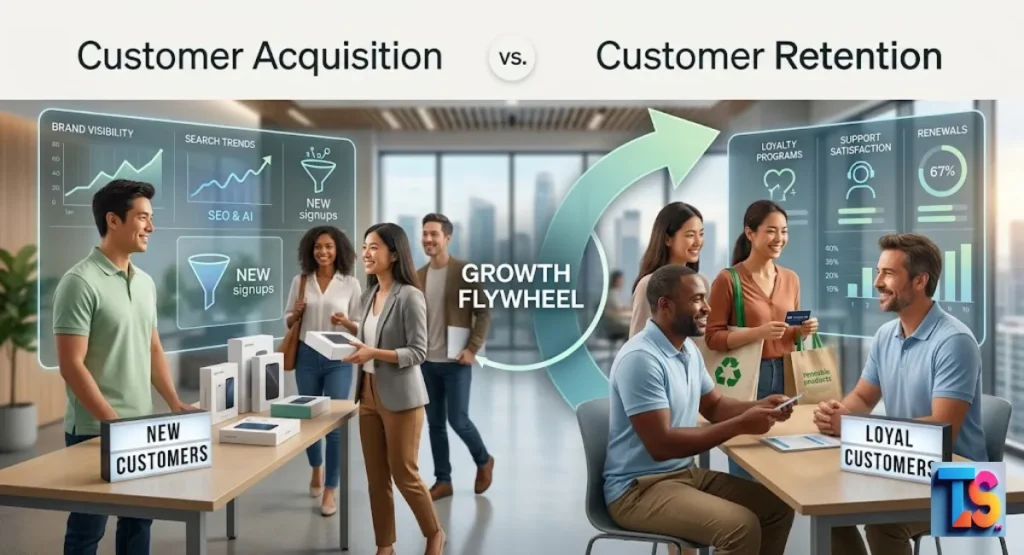
Customer acquisition is the process of winning brand new buyers, while customer retention is the process of keeping your existing buyers active and loyal over time. Acquisition focuses on initial market reach and customer volume, whereas retention focuses on relationship depth and repeat purchase value.
Understanding this basic difference allows businesses to distribute their resources wisely. Winning a customer requires heavy front-end marketing campaigns to build trust from scratch. On the other side, keeping a customer relies on excellent service and continuous satisfaction to prevent them from leaving for a competitor.
What is Customer Acquisition? (Definition & 2026 Channels)
Customer acquisition is the strategic business practice of identifying, attracting, and converting prospects into entirely new paying clients for your brand. To deploy this strategy successfully, teams must understand What Is Client Acquisition and how its mechanics shift in a digital landscape that prioritizes user data protection. Fundamentally, client acquisition means systematically guiding a cold target audience through a structured sales cycle until they make their first official transaction.
According to a 2026 marketing study by Public Media Solution, the channels used to win new buyers have evolved due to the elimination of third-party tracking cookies. Modern businesses can no longer rely on old digital tracking methods to spot buyers. Instead, companies win new accounts by using the following native channels:
- Search Engine Visibility: Creating high-value informational content that solves exact user questions so prospects discover your brand naturally.
- Permission-Based First-Party Data: Gathering contact information directly from users through helpful free downloads, quizzes, or newsletters.
- Intelligent Ad Platforms: Using social media advertising networks driven by predictive math models that match your offers with interested audiences automatically.
The Modern Customer Acquisition Funnel
The modern customer acquisition funnel is a structured multi-stage framework that maps out how a stranger transitions into a brand-new paying customer. This visual and operational pathway helps marketing teams track where potential buyers drop off during the sales process.
A functional client acquisition system divides this journey into three distinct parts. The process starts at the awareness stage, where a prospect discovers your brand through helpful web searches or social media. Next is the consideration stage, where the prospect compares your specific features and prices against other options. Finally, the funnel ends at the conversion stage, where a specialized client acquisition manager or a streamlined online checkout completes the initial sale.
Top Tactics for Driving New Customer Volume
The top tactics for driving new customer volume involve using modern automation tools and industry-specific marketing strategies to build a reliable sales pipeline. These methods allow your business to scale up its customer numbers predictably.
A popular method is deploying a client acquisition bot to engage website visitors instantly, answer their questions, and schedule sales meetings without human delay. For professional services, using targeted client acquisition strategies for financial advisors helps build deep community trust through free educational workshops. If you run a corporate service agency, successful b2b client acquisition relies on direct email outreach and detailed case studies to solve specific client problems.
How to Calculate Customer Acquisition Cost (CAC)
Customer Acquisition Cost is calculated by taking the total money spent on sales and marketing campaigns over a set period and dividing it by the exact number of new customers won in that same time frame. This measurement tells you the average amount of money required to buy a single new buyer relationship.
To get an accurate number, you must add up your direct ad spend, marketing software fees, and sales team salaries. You can easily calculate your business acquisition costs by using the following mathematical formula:
$$\text{CAC} = \frac{\text{Total Marketing Costs} + \text{Total Sales Costs}}{\text{Number of New Customers Acquired}}$$

What is Customer Retention? (Definition & Loyalty Frameworks)
Customer retention is the strategic process of keeping your existing buyers satisfied, so they continue to buy your products or services over a long period. It relies on structured loyalty frameworks that systematically reward customers for remaining dedicated to your brand instead of switching to a competitor.
According to 2026 data published by DemandSage, focusing heavily on retention creates a reliable foundation for predictable monthly revenue. Popular loyalty frameworks include tiered reward programs, early product testing opportunities, and proactive account reviews that ensure your users get continuous value from their purchases.
Post-Purchase Strategies That Prevent Churn
Post-purchase strategies prevent churn by delivering immediate guidance and top-tier support to a customer the exact moment they finish their first transaction. These steps ensure that new buyers do not experience confusion or regret after spending their money.
Industry reports from ConvergeHub in 2026 show that clear onboarding guides drastically reduce early cancellations. Brands can also use automated system messages to check in on user progress and solve technical bugs before the customer gets frustrated. Sending unexpected product tips or exclusive loyalty discounts also keeps buyers happy and connected to your business.
How to Calculate Customer Retention Rate (CRR)
Customer Retention Rate is calculated by taking the number of customers at the end of a specific period, subtracting any new customers won during that time, dividing the result by the number of customers you had at the start, and multiplying by 100. This metric shows the exact percentage of your user base that stays loyal to your brand.
To calculate this rate correctly, you must closely track your customer counts at the beginning and end of the month or year. Use this standard formula to find your business retention percentage:
$$\text{CRR} = \left( \frac{\text{Ending Customers} – \text{New Customers}}{\text{Starting Customers}} \right) \times 100$$

Maximizing Profits via Customer Lifetime Value (CLV)
Maximizing profits via Customer Lifetime Value means increasing the total amount of money a single customer spends with your business throughout their entire relationship with your brand. The longer a customer stays with you, the more valuable they become to your bottom line.
A 2026 industry report from GTM 8020 explains that existing customers are much more likely to try your premium upgrades than new visitors. You can maximize this value by recommending complementary tools and offering long-term subscription options that save the customer money while keeping them in your product ecosystem for years.
The Financial Contrast: Why Retention Costs 5x Less Than Acquisition
Keeping an existing customer costs five times less than winning a new one because you do not have to pay expensive advertising networks to recapture their attention. Retaining a current buyer relies on direct, affordable communication tools like automated email campaigns or helpful customer service chats.
According to data from DemandSage, repeat customers spend significantly more money per order on average when compared to first time shoppers. This major difference in spending behavior means that moving a portion of your budget from paid ads to loyalty programs naturally expands your business profit margins.
The Rising Costs of Paid Advertising and Privacy Changes
Paid advertising has become incredibly expensive due to major platform changes that protect user data, which makes it much harder for businesses to target specific online crowds easily. Because digital ads are less precise, brands must spend far more money on ad auctions just to reach the same number of prospects.
A 2026 study by Amra and Elma shows that digital customer acquisition costs have spiked by over 18% year over year. This ongoing inflation forces businesses to look for the best strategies for client acquisition that do not rely completely on paid ad networks. For example, business owners navigating staffing industry client acquisition challenges are bypassing expensive banner ads entirely and investing heavily in organic content networks to attract clients affordably.
The Math Behind Why a 5% Retention Boost Increases Profits by 25%+
A tiny 5% boost in your customer retention rate can increase your overall business profits by 25% to 95% because repeat buyers do not require any customer acquisition costs. Every dollar you save on expensive ad placement goes directly into your business savings.
The following comparison table outlines how business metrics and overall costs contrast between an acquisition-heavy strategy and a retention-focused strategy.
| Financial Metric | Focus on Acquisition | Focus on Retention |
| Primary Marketing Cost | High-paidClient Acquisition Manager ad bidding fees | Low email and support software costs |
| Average Order Value | Baseline customer spend | 67% higher average order spend |
| Profit Margin per User | Compressed by high ad costs | Expanded by zero repeat ad fees |
| Revenue Predictability | Unpredictable and volatile | Highly stable and recurring |
Strategic Framework: When to Prioritize Acquisition vs. Retention
A business must prioritize customer acquisition when it needs to build its initial user base from zero, and pivot to customer retention when it needs to protect its market share and maximize overall profit margins. The exact timing of this strategic shift depends on the age of your company and the type of product you sell.
The following guide serves as a strategic checklist to help your management team direct your corporate budget based on your current business stage.
| Business Growth Stage | Primary Focus | Recommended Tool or Strategy |
| Brand New Startup Launch | 90% Acquisition / 10% Retention | Search visibility and search engine ads |
| Scaling Customer Base | 60% Acquisition / 40% Retention | Automated client acquisition bot software |
| Established Market Leader | 30% Acquisition / 70% Retention | Dedicated customer success managers |
| High Customer Cancellation Era | 10% Acquisition / 90% Retention | Upgraded user onboarding and feedback loops |
Early-Stage Startups: Why Acquisition is Essential
Early-stage startups must place their full focus on customer acquisition because they need to build an initial customer base to survive. You cannot retain or nurture a group of buyers until you have successfully brought them into your business ecosystem.
During this starting phase, spending more money to build brand awareness is completely necessary. Startups use this initial influx of buyers to collect user reviews, test product quality, and establish a foundational community that can later be funneled into automated retention programs.
Mature Businesses: The Pivot to Retention and Enterprise Value
Mature businesses must shift their main focus to retention because losing old customers as fast as you acquire new ones creates a stagnant brand that cannot scale. Venture capital firms and buyers place the highest financial value on brands with stable, predictable revenue.
According to a 2026 book on unit economics by Lech Kaniuk, companies that ignore retention experience a leaking bucket problem that stops growth completely. Investing heavily in customer retention protects your existing market share and builds long-term enterprise value.
Business Model Nuances: E-commerce vs. B2B SaaS
The exact balance between winning new buyers and keeping old ones depends heavily on whether your company sells physical consumer products or monthly software subscriptions.
- E-commerce: Online retail brands face rapid buyer choices and shifting ad prices. A 2026 article by Ringly.io notes that digital shops use fast acquisition to capture seasonal trends, but rely on post-purchase email discounts to win crucial second and third orders.
- B2B SaaS: Software as a service companies rely completely on multi-year subscription models to remain profitable. Because winning a new corporate account takes months of sales calls, keeping those clients happy through continuous software updates is mandatory for business survival.
The Growth Flywheel: How Retained Customers Lower Your Total CAC
The growth flywheel is a business model where happy, retained customers naturally recommend your brand to their professional peers, which brings in new buyers without any added advertising costs. This ongoing referral loop creates a self-sustaining system that lowers your average cost to win customers over time.
According to data from the 2026 book LTVCACBook, companies that lead with organic content and happy customer communities experience a blended customer acquisition cost that is 60% lower than paid-heavy competitors. Taking care of your current users transforms them into an unpaid marketing force that works for your brand around the clock.

Turning Brand Advocates into Organic Referral Engines
Turning brand advocates into organic referral engines means building an amazing product experience that inspires your customers to talk about your business online. Referrals come to your sales team with built-in trust, making them much easier to convert into paying clients.
A 2026 consumer report by Amra and Elma shows that over 92% of buyers trust recommendations from friends far more than traditional corporate advertisements. By dedicating your resources to customer happiness, you create a powerful network of brand fans who naturally bring in your next wave of business growth for free.
FAQs
Is customer retention always cheaper than acquisition?
Yes, customer retention is always cheaper than acquisition because you do not have to pay competitive ad bidding fees to get the attention of an existing buyer. You are communicating directly with an audience that already knows, likes, and trusts your company. The only rare exception is if your product has a massive defect that requires expensive, custom engineering fixes to keep a large client from leaving.
What is a healthy benchmark for customer retention rate?
A healthy customer retention rate for most commercial industries sits at around 75%, though the exact number depends on your business model. Data from DemandSage shows that successful software brands look for a retention rate above 85% to sustain their growth. Meanwhile, traditional e-commerce shops often see lower retention numbers but focus on driving up repeat purchase frequencies.
What is the main cause of high customer churn?
The main cause of high customer churn is poor customer service and a lack of clear product value right after a sale is completed. According to 2026 customer support data from ConvergeHub, if a buyer feels abandoned after they hand over their money, or if your software is too complicated to use without guidance, they will quickly leave and join a competitor.