When complex corporate sales pipelines stall, the problem is rarely the product itself. The issue is usually a broken customer acquisition system. Traditional sales playbooks drop in performance because modern buyers mask their identities behind a self-serve research model.
High-performing organizations require structured, multi-channel pipelines to ensure predictable revenue growth. Mastering b2b client acquisition allows enterprise teams to identify high-value accounts, engage key decision-makers, and shorten conversion timelines effectively.
At the core of this growth is a fundamental question: What Is Client Acquisition in a modern enterprise setting? It is the programmatic process of identifying, engaging, and securing new corporate contracts. It combines multi-channel outbound outreach, inbound content engines, and targeted account strategies into a single revenue pipeline. Winning high-ticket accounts requires systematic qualification, formal financial justification, and complete alignment between marketing and sales departments.
The Revenue Bridge: Successful customer acquisition relies on tight integration between lead cultivation and the pipeline management system. Inbound corporate traffic creates initial intent signals, but outbound reps must multi-thread into the account to progress the deal. When automated workflows and CRM pipelines track the exact same criteria, revenue models scale naturally.
What Is B2B Client Acquisition?
Business-to-business customer acquisition is the programmatic system an organization uses to find and secure new corporate accounts. This process handles longer enterprise sales cycles, maps multiple corporate decision-makers, and manages large-scale budget approvals. It differs from consumer models by prioritizing long-term relationship value over quick, single-session checkouts.
Defining the core parameters of client acquisition provides a clear operational template for corporate sales teams looking to implement the best strategies for client acquisition within their respective industries.
Defining the Modern B2B Journey
The corporate sales cycle is no longer linear. Content Marketing Institute data shows that modern business buyers consume an average of 13.4 pieces of content before interacting with an outbound representative.
Prospects complete up to 67% of their research phase anonymously through whitepapers, third-party product reviews, and case studies. The acquisition model must capture these early high-intent signals through data enrichment tools like ZoomInfo or Clearbit to identify corporate traffic early.
The Referral Trap
Relying entirely on word-of-mouth creates an unpredictable revenue pipeline. While referral business yields high close rates, it lacks a predictable scaling mechanism. Companies facing competitive pressures, such as recruitment firms working through complex staffing industry client acquisition challenges, often hit growth ceilings when relying solely on passive networks. A formal client acquisition system replaces chance occurrences with repeatable multi-channel campaigns. This ensures a constant volume of sales-qualified leads enters the top of the funnel every month.
B2B vs. B2C Acquisition
Purchasing behaviors between corporate accounts and consumers differ fundamentally. Corporate transactions carry higher initial risk, demanding extensive internal alignment across multiple tiers of management.
| Feature | Business-to-Business (B2B) | Business-to-Consumer (B2C) |
| Committee Size | 6 to 12 stakeholders | 1 individual buyer |
| Cycle Duration | 90 to 218 days | Minutes to hours |
| Evaluation Factors | Quantifiable ROI and risk mitigation | Personal emotion and price |
| Contract Structure | Multi-year SLAs and annual recurring revenue | Single transactional checkouts |
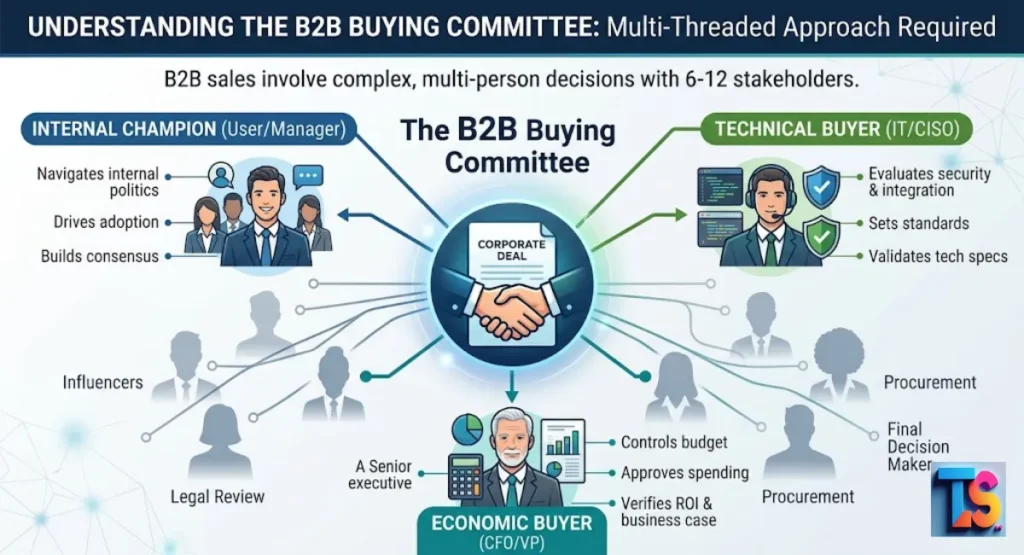
Understanding the B2B Buying Committee
The enterprise purchasing group consists of internal stakeholders who evaluate, audit, and approve vendor software and services. Modern corporate sales cycles involve multiple departments, including finance, security, operations, and procurement. Successfully closing high-ticket deals requires mapping each stakeholder’s concerns to prevent mid-funnel friction.
Deals rarely stall due to lack of budget. They fail because an unmapped stakeholder blocks progression at the procurement stage.
Identifying Key Stakeholders
Forrester data confirms that the median corporate buying group for contracts exceeding 50,000 dollars now includes 11.2 distinct people. Single-threaded sales conversations, where an executive speaks to only one internal champion, yield low close rates. Multi-threaded outreach targeting five or more committee members boosts win rates significantly.
- The Internal Champion: This individual manages the target team day-to-day. They want a practical solution to eliminate immediate team friction but lack final budget signature authority.
- The Technical Buyer: This group includes IT directors and Chief Information Security Officers. They audit data security protocols, integration support, and implementation complexity.
- The Economic Buyer: Typically a VP or C-suite executive with full budget ownership. They assess the contract through a strict financial lens, looking at cost-to-value ratios.
Creating Your Ideal Customer Profile (ICP)
An Ideal Customer Profile template standardizes target list segmentation across outbound teams. It uses firmographic segmentation data to filter out low-value accounts early. Define these core metrics within your customer relationship management software:
- Annual Revenue Floor: Set clear thresholds, such as a minimum of 20 million dollars in annual revenue, to filter out accounts unable to afford enterprise tier pricing.
- Headcount Benchmarks: Track department-specific sizes using LinkedIn Sales Navigator filters to verify operational fit.
- Technographic Profile Mapping: Document existing software environments via tools like BuiltWith to target companies with compatible technology stacks.
Developing User Personas
A comprehensive buyer persona matrix details the individual motivations within your core ICP. While firmographics define the corporate target, personas guide the specific messaging inside your automated email sequences.
For instance, an enterprise security director requires validation regarding data encryption standards. Conversely, an operations lead wants proof that the platform will mitigate implementation friction and save weekly production hours.
Core Channels for Acquiring B2B Clients

Corporate client acquisition uses a combination of inbound demand generation and highly targeted outbound account strategies. Top-performing marketing models allocate budgets across organic search visibility, account-based workflows, and digital educational events. Balancing these channels creates a stable pipeline that cushions against shifts in single ad platforms.
Relying on a single acquisition channel introduces systemic operational risk into the corporate growth model.
Organic Search Visibility & Inbound Marketing
Organic search visibility remains an exceptionally stable channel for capturing high-intent transactional keywords. By mapping content to specific stages of the research model, businesses capture prospects actively searching for alternative vendor solutions.
Focus development on original industry benchmarks, case studies, and calculators. This inbound lead generation engine lowers customer acquisition costs by continually drawing in targeted traffic without escalating daily digital ad spend.
Account-Based Marketing (ABM)
An Account-Based Marketing framework treats every high-value whale account as an individual market segment. Marketing and sales teams design custom content experiences for a small, predefined target account list. This approach synchronizes custom LinkedIn display advertising with personalized landing pages built for the specific target corporation. According to ITSMA benchmarks, ABM tactics deliver a higher return on investment than general marketing campaigns for most enterprise business operators.
Value-First Outbound Outreach
High-yield cold email outreach succeeds when mass blasting is replaced by personalization at scale. Outbound prospecting automation tools like Instantly or Salesloft send multi-step cadences to selected buyers. Modern growth teams frequently leverage an autonomous client acquisition bot or predictive AI agent to scour professional platforms, detect intent signals, and personalize initial touchpoints. Every initial touchpoint must deliver immediate structural value, such as a complimentary process audit or custom dataset analysis, rather than requesting an immediate sales pitch.
Industry Events and Digital Webinars
Digital events and live conferences serve as critical trust-building accelerators for extended sales funnels. Webinars targeting niche operational challenges allow subject matter experts to display thought leadership content marketing directly to active prospects. Lead scoring workflows track how long attendees remain logged in, immediately routing high-engagement leads to sales teams for discovery outreach.
Overcoming Key Buyer Pain Points
Modern enterprise buyers face major financial, operational, and structural roadblocks when evaluating third-party solutions. Corporate procurement requires vendors to provide rigorous proof of economic impact and clear onboarding playbooks. Addressing these anxieties early in the discovery phase prevents late-stage pipeline drop-offs.
Enterprise sales teams must address institutional friction systematically during early-stage presentations.
Financial Friction
Every significant corporate expense undergoes strict review by risk-averse CFOs. To counter this friction, sales assets must include clear financial models demonstrating contract value expansion and capital payback timelines. Providing verifiable data showing how the product reduces external labor costs or eliminates redundant software licenses helps internal champions justify the purchase to the finance team.
Operational Anxiety
Corporate buyers worry about the implementation chaos that often follows a new software deployment. Mitigate this anxiety by providing a standardized 30-day onboarding blueprint during the evaluation process. Show precisely how data migration occurs, which internal resources are required, and how technical support handles system handoffs without disrupting daily operations.
Trust Deficit
Corporate procurement teams avoid choosing unproven platforms. Build quick institutional credibility by highlighting third-party validation, including G2 Leader badges, SOC 2 Type II compliance reports, and deep-dive enterprise case studies. Displaying clear testimonials from recognizable brands reduces perceived buyer risk during early discovery calls.
Optimizing the B2B Sales Funnel
Funnel optimization turns raw inbound traffic into closed corporate revenue using systematic qualification rules. GTM teams use standardized grading frameworks to distinguish between early researchers and active buyers. Tracking conversion transitions allows sales leaders to resolve pipeline bottlenecks and increase overall close rates.
Maximizing sales funnel efficiency requires clear definitions for every stage of the pipeline.
Lead Capture and Qualification
A clear lead qualification framework stops account executives from wasting time on low-intent leads. Marketing qualified leads display basic behavioral intent, such as downloading a whitepaper. To become a sales-qualified lead, the account must pass exact grading criteria during discovery. Many organizations use the BANT matrix to verify alignment before scheduling advanced technical product demonstrations.
1.Verify Budget:Financial Fit.
Confirm the prospect has an active, allocated budget folder for this specific project category. This avoids spending hours on accounts that lack capital.
2.Confirm Authority:Stakeholder Mapping.
Verify that the contact is directly involved in the corporate buying committee or acts as an approved internal champion for decision-making.
3.Assess Core Need:Operational Alignment.
Document the precise operational bottlenecks the target team faces. Ensure their requirements match your core platform features.
4.Establish Timeline:Velocity Check.
Determine if the company plans to implement a chosen vendor solution within the next three to six months before passing them to the sales team.
The Discovery and Demo Process
The initial discovery call should focus on diagnosing process challenges rather than showcasing software features. Use a standardized discovery call checklist to ensure team consistency. Document the precise operational metrics the target team is currently missing. Identify the exact software integrations required for successful data flow. Confirm the key corporate stakeholders who must join the next deep-dive demonstration and establish a mutually agreed date for the subsequent pipeline review session.
Handling Corporate Objections
Expect objections around pricing tiers and implementation timelines during late-stage negotiations. Rather than discounting core pricing models, preserve contract margin by restructuring contract terms, offering extended onboarding support, or staging deployment schedules across departments. Frame every answer around long-term contract value expansion to protect baseline platform margins.
Key Metrics to Track Success

Measuring corporate client acquisition health requires close tracking of program costs, lifetime revenues, and overall pipeline velocity. These performance indicators show whether customer acquisition investments yield sustainable, scalable business growth. Accurate data analysis ensures marketing capital is distributed strictly to high-return channels.
Relying on vanity metrics like impressions or clicks obscures the true health of commercial revenue systems.
Customer Acquisition Cost (CAC)
Customer acquisition cost calculates the total financial investment required to gain a single new business customer. This calculation must include all digital media spend, outbound sales salaries, software stack overhead, and agency fees. Calculate the baseline acquisition metric using this mathematical formula:
$$CAC = \frac{\text{Total Marketing Costs} + \text{Total Sales Expenses}}{\text{Number of New Customers Acquired}}$$
Customer Lifetime Value (LTV)
Customer lifetime value estimates the total gross revenue a single corporate account generates over the entire duration of their contract relationship. Tracking this indicator helps sales leaders understand exactly how much capital can be safely spent to win an individual account. Maintain a healthy business profile by targeting a baseline LTV to CAC ratio of at least 3 to 1.
A vital strategic balance to analyze is Customer Acquisition vs Retention. While an engine must continuously feed the top of the funnel, keeping up-front acquisition costs sustainable relies heavily on retaining corporate clients long enough to maximize their contractual value over their lifetime.
Pipeline Velocity
Pipeline velocity measures the speed at which prospective corporate opportunities move through the sales tracking ecosystem to become closed-won accounts. Accelerating this metric directly drives higher quarterly revenue without forcing massive increases in top-of-funnel lead generation budgets. Track pipeline progression speeds using this standard calculation:
$$Velocity = \frac{\text{Number of Open Opportunities} \times \text{Average Deal Value} \times \text{Win Rate Percentage}}{\text{Sales Cycle Length in Days}}$$
Conclusion: Building a Scalable Acquisition Engine
Establishing a reliable enterprise acquisition engine requires continuous optimization across software platforms, targeting lists, and team plays. Organizations must replace ad-hoc outbound motions with systematic multi-channel workflows to secure consistent long-term growth. Standardizing funnel benchmarks prepares operations to scale safely into competitive spaces.
Sustained corporate expansion requires a predictable client acquisition architecture built for multi-department buyers.
Summary of Next Steps
Begin by running a thorough audit of current database systems to verify target profile alignment. Update internal workflows to ensure outbound prospecting automation sequences deploy data-backed messaging directly to specific buyer personas. Eliminate single-threaded communication habits by training representatives to connect with multiple stakeholders across every target account.
Final Call to Action
Review your core CRM pipeline tracking rules this week. Identify where mid-funnel deals frequently stall, implement automated multi-step email nurture cadences, and arm your internal champions with the exact technical validation assets needed to accelerate institutional approval cycles.
Action Plan Checklist:
- Audit existing CRM workflows: Align marketing qualified lead criteria with sales requirements.
- Build a target list: Segment data parameters using updated firmographic filters.
- Construct an outbound playbook: Target at least five committee roles per company.
- Set up nurture sequences: Focus campaigns on resolving post-demo operational anxiety.
- Launch discovery checklists: Prevent unqualified opportunities from slowing down pipelines.
- Calculate baseline metrics: Evaluate customer acquisition cost and lifetime value across sources.
FAQs
What is a client acquisition system?
A client acquisition system is a structured infrastructure of marketing software, data filters, and outreach workflows that operate together to identify, nurture, and close corporate accounts. It replaces unpredictable networking with data-backed, repeatable channel tactics to generate a predictable revenue pipeline.
What does a client acquisition manager do?
A client acquisition manager oversees the strategies, channel budgets, and cross-department pipelines responsible for bringing new accounts into the business. They focus on minimizing customer acquisition cost, accelerating pipeline velocity, and maintaining alignment between lead generation programs and account executives.
How do financial advisors secure corporate accounts?
When developing client acquisition strategies for financial advisors, teams find success by leading with deep, specialized educational content, such as regulatory compliance updates or corporate retirement asset structural changes. They avoid generic sales pitches, using value-first webinars and targeted LinkedIn social selling techniques to build trust with risk-averse CFOs and HR directors.
What are the main client acquisition challenges in the staffing industry?
The staffing industry faces severe acquisition challenges around product differentiation and fluctuating economic cycles. Recruitment agencies overcome these bottlenecks by building specialized inbound lead generation engines that target niche talent shortages, combined with data enrichment platforms to identify companies facing sudden hiring surges.
Should we use a client acquisition bot for corporate sales?
Automated tools help handle early-stage data tasks like firmographic profile mapping and list cleaning, but they cannot replace human interaction for complex deals. Use automation strictly to qualify inbound traffic, enrich records, and trigger internal alerts within your CRM platform.